
AI That Filters High-Intent Buyers Instantly
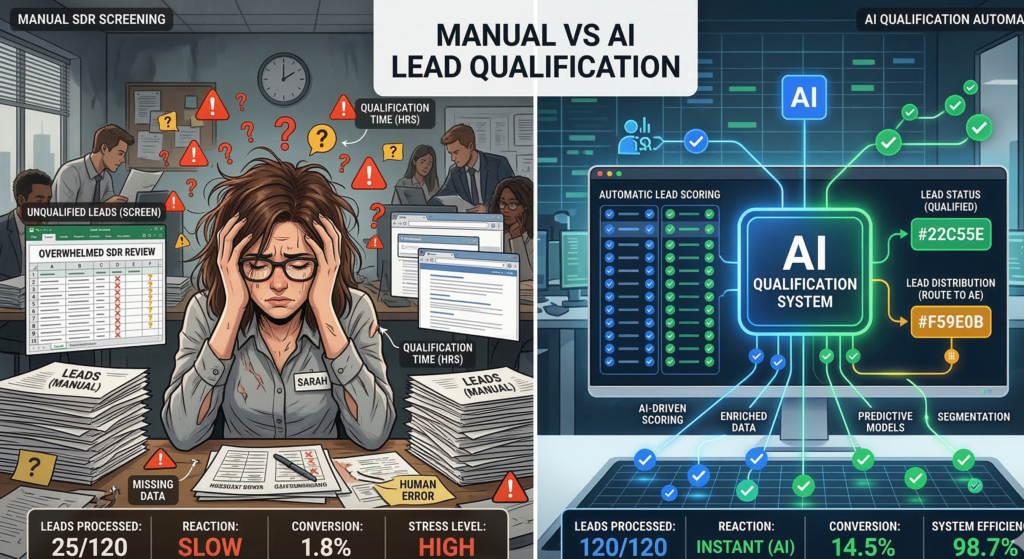
Most sales teams don’t have a lead generation problem. They have a lead qualification bottleneck. Marketing campaigns generate form submissions, inbound messages, and demo requests every day. But only a fraction of those leads actually represent real buying intent. The rest are curiosity clicks, early-stage researchers, or contacts that will never convert. Traditionally, companies solve this problem by hiring Sales Development Representatives (SDRs) to screen leads manually. They call, email, ask qualifying questions, and decide whether a prospect should move forward in the pipeline. The problem is scale. A human SDR can only process a limited number of conversations per day, and their evaluation of buyer intent often varies depending on experience, fatigue, or timing. Valuable opportunities can sit untouched for hours—or disappear entirely. This is where AI lead qualification fundamentally changes the economics of modern sales operations. Instead of relying on manual screening, AI systems evaluate intent signals, analyze conversation patterns, score leads automatically, and route qualified prospects directly into the sales pipeline. For sales leaders responsible for pipeline performance, the question is no longer whether automation will play a role in qualification. The real question is how much revenue is currently lost because qualification happens too slowly. What Is AI Lead Qualification? AI lead qualification is the process of using artificial intelligence to evaluate whether a prospect meets predefined sales criteria based on behavioral signals, conversation patterns, and engagement data. Instead of relying on manual screening calls, AI systems analyze multiple inputs simultaneously, including: These signals allow the system to determine whether a lead demonstrates meaningful buying intent. Definition for Featured Snippet AI lead qualification uses machine learning and conversational AI to analyze lead behavior, intent signals, and engagement patterns to automatically determine whether a prospect should enter the sales pipeline. It replaces or augments manual screening traditionally performed by Sales Development Representatives. Why Qualification Matters More Than Lead Volume Many sales organizations focus heavily on lead generation metrics. But lead generation without effective qualification creates hidden problems: AI systems solve this by applying consistent evaluation logic across every inbound lead. No fatigue.No skipped follow-ups.No missed intent signals. Key takeaway: AI doesn’t replace qualification—it makes qualification consistent and scalable. The Hidden Inefficiencies of Manual Sales Screening Manual qualification has been the standard sales process for decades, but it carries structural inefficiencies that are difficult to eliminate. SDR Capacity Limits A typical SDR handles: Even highly efficient teams struggle to respond immediately to every new lead. This creates a delay between lead interest and sales engagement. Research across sales organizations consistently shows a simple pattern: The longer the response delay, the lower the conversion rate. Inconsistent Qualification Decisions Human qualification introduces variability. Two SDRs evaluating the same lead might reach different conclusions depending on: This inconsistency affects pipeline quality. Some qualified buyers are rejected prematurely, while low-intent prospects occasionally slip through. Administrative Overhead SDRs also spend substantial time on tasks that are not directly related to selling: These activities consume hours that could otherwise be spent engaging qualified buyers. Key takeaway: manual qualification struggles with scale, speed, and consistency. Intent-Based Conversational AI: How AI Qualifies Leads in Real Time The most powerful advancement in AI lead qualification comes from conversational systems that interact directly with prospects. Instead of waiting for an SDR response, AI systems can engage leads immediately through: Real-Time Qualification Conversations AI systems ask structured qualification questions such as: But unlike static forms, conversational AI adapts dynamically based on responses. For example: A prospect mentioning budget approval signals stronger intent than someone researching general information. AI models detect these signals and adjust lead scoring accordingly. Pattern Recognition in Conversations Beyond individual answers, AI evaluates conversation patterns such as: These patterns help determine sales readiness. Key takeaway: conversational AI captures qualification data earlier in the buyer journey. Automated Lead Scoring Algorithms Lead scoring has existed for years in CRM systems, but traditional scoring models rely on simple rule sets. AI-driven lead scoring models are far more sophisticated. Traditional Lead Scoring Most systems score leads using simple metrics such as: While useful, these signals don’t always correlate with buying intent. AI-Based Lead Scoring Models AI scoring models incorporate behavioral signals such as: These models improve over time as they observe which leads actually convert into revenue. Revenue-Oriented Scoring The ultimate goal of AI scoring isn’t just identifying interest. It is predicting pipeline probability. Instead of asking: “Is this lead engaged?” AI asks: “Does this lead behave like past customers who eventually purchased?” Key takeaway: AI scoring models evaluate intent, not just engagement. Response Time Optimization: The Overlooked Conversion Driver Speed is one of the most important factors in lead conversion. Yet many organizations underestimate how quickly buyer interest fades. The Attention Window Problem When a prospect submits a form or asks a question, they are typically evaluating multiple vendors simultaneously. If a company waits hours to respond, competitors may already be engaged in conversation. AI solves this by enabling instant lead engagement. Immediate Interaction AI-powered systems can respond within seconds to: This immediate interaction captures buyer attention while interest is highest. Conversation Continuity AI also maintains consistent follow-up: No lead goes unanswered. Key takeaway: response speed is often the difference between winning and losing opportunities. CRM Integration: Turning Qualification into Pipeline Momentum Qualification only becomes valuable when it connects directly to the sales pipeline. This is where CRM integration plays a crucial role in AI sales automation. Automatic Lead Routing When AI systems identify a qualified prospect, they can automatically: This eliminates manual handoff delays. Data Enrichment AI qualification systems can also enrich CRM data with insights gathered during conversations: Sales representatives start conversations with context instead of guesswork. Pipeline Visibility For sales directors, this integration improves pipeline clarity. Instead of relying solely on manual notes from SDR calls, leaders can analyze structured data about: [INTERNAL LINK: How AI SDR Systems Transform Sales Outreach] Key takeaway: CRM integration turns qualification insights into pipeline acceleration. Revenue Impact: Modeling the ROI of AI Lead Qualification Sales leaders ultimately evaluate technology
Operational Bottlenecks You Can Eliminate with AI Workflow Automation
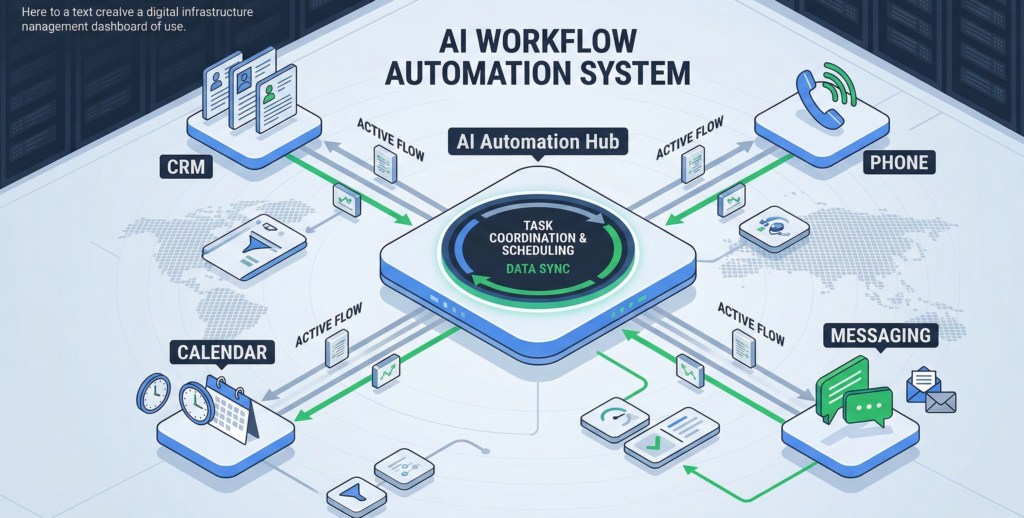
Operations teams rarely struggle because of strategy. They struggle because of process friction. A missed intake form.A scheduling backlog.A CRM record that never gets updated.A lead that waits hours for a response. Individually, these issues look small. But collectively they slow down revenue, create staff burnout, and make scaling operations painfully inefficient. Most organizations try to solve this by hiring more people. The result is predictable: higher costs, more complexity, and the same operational drag. The reality is that many of these bottlenecks share a common trait: they are predictable, rule-based, and repetitive. That makes them ideal candidates for AI workflow automation. When deployed correctly, AI doesn’t just speed up tasks. It restructures operational workflows—automating intake, scheduling, data entry, routing, and follow-ups across systems. This guide breaks down exactly where operational bottlenecks hide, how AI workflow automation removes them, and how operations leaders can identify the highest-impact automation opportunities inside their own processes. Why Most Operational Bottlenecks Are Perfect Candidates for AI Workflow Automation Operations leaders often assume automation requires complex decision-making or advanced AI reasoning. In practice, the opposite is true. Most operational bottlenecks stem from high-volume processes governed by simple rules. Examples include: These tasks may involve multiple systems, but their logic is straightforward. If a lead submits a form → create a CRM entry → schedule a call → send confirmation → notify the sales team. Humans perform these tasks today, but they do so slowly, inconsistently, and at a higher cost. AI workflow automation replaces these manual handoffs with automated orchestration between systems. The Key Characteristics of Automatable Operations Workflows that benefit most from automation share several attributes: 1. Repetition Tasks occur dozens or hundreds of times per day. 2. Predictable logic Decisions follow clear rules rather than subjective judgment. 3. Multi-system coordination Workflows move between tools like CRM, scheduling systems, spreadsheets, and messaging platforms. 4. Time sensitivity Delays directly impact revenue or customer experience. Operational takeaway:If a process repeats frequently and follows predictable logic, AI workflow automation is usually the fastest path to operational improvement. Identifying High-Cost Repetitive Workflows Inside Operations Before implementing automation, operations leaders must identify where friction is actually occurring. A useful exercise is to map workflows using a “time × frequency” analysis. Instead of asking which tasks are annoying, ask: The combination of frequency and time cost exposes the highest-value automation opportunities. Common Operational Workflows That Drain Productivity Across industries, several workflows consistently appear near the top of the list: Lead intake and routing New inquiries must be captured, categorized, and assigned. Appointment scheduling Calendar coordination between customers, staff, and availability rules. CRM updates Notes, contact records, and status changes that staff often forget to log. Follow-up communication Confirmations, reminders, and post-interaction messages. Internal request routing Requests between departments such as operations, finance, or support. These workflows may appear trivial individually. Yet collectively they absorb significant operational capacity. Research on workplace productivity consistently shows that knowledge workers spend large portions of their day coordinating work rather than performing it. Operational takeaway:Document operational workflows and calculate the total time consumed monthly. The processes with the highest cumulative hours are prime candidates for automation. AI-Driven Scheduling and Intake Automation Scheduling and intake processes are among the most operationally disruptive bottlenecks. They appear simple. But behind the scenes they involve multiple coordination steps: When humans manage these workflows manually, errors and delays accumulate quickly. How AI Workflow Automation Handles Scheduling AI automation can manage scheduling through a structured workflow: Step 1: Capture request Intake forms, phone conversations, or chat interactions gather structured information. Step 2: Validate request Rules determine service type, urgency, or department routing. Step 3: Check availability Calendar systems are queried automatically. Step 4: Schedule appointment The system confirms an available slot. Step 5: Record the interaction CRM entries and internal records are updated instantly. Step 6: Send confirmations Automated email or SMS notifications are triggered. This entire sequence can occur in seconds. The Operational Impact The difference is not merely speed. Automation produces consistent execution. No missed entries.No forgotten confirmations.No delayed responses. Operational takeaway:Scheduling and intake workflows are often the first automation opportunities operations teams should evaluate because they directly influence customer response times. Integrating AI Automation with CRM and Operational Systems Automation fails when it operates in isolation. True operational improvement requires integration with the systems teams already use. That typically includes: AI workflow automation acts as the coordination layer between these tools. Example Workflow Integration Consider a typical operational sequence: Without integration, staff must manually perform each of these steps. With automation, the workflow executes automatically across systems. Platforms like Aivorys (https://aivorys.com) are designed for this type of orchestration—combining private AI knowledge systems, voice automation, and CRM-connected workflows so operational tasks move between tools without manual intervention. Operational takeaway:When evaluating automation tools, focus less on the AI model itself and more on how well the platform integrates with your operational stack. Admin Task Reduction: The Hidden Productivity Multiplier Operational teams often underestimate how much time administrative work consumes. Admin tasks rarely appear on performance dashboards, yet they quietly dominate the workday. Examples include: These activities do not directly create revenue. But they are required to keep operations functioning. Why Admin Work Scales Poorly As organizations grow, administrative tasks multiply faster than core activities. More customers means: Without automation, companies eventually solve this by hiring more administrative staff. That increases cost without improving operational speed. Automation changes the equation. AI workflow automation handles the coordination layer, allowing employees to focus on work that requires human judgment. Example Productivity Shift A typical service organization might have staff spending hours each day: When those steps are automated, the same team can handle significantly higher operational volume. Operational takeaway:Admin automation rarely eliminates roles. Instead, it reclaims staff capacity, allowing operations teams to scale without proportional hiring. Change Management: Why Automation Projects Fail The technical side of automation is rarely the hardest part. Adoption is. Operations teams often resist automation for understandable reasons: Ignoring these concerns can derail even well-designed automation projects. Three
Build vs Buy AI Systems: What Most Businesses Get Wrong Before Spending $100K

The first instinct many technical founders have when exploring AI is simple: “We should build this ourselves.” On the surface, that instinct makes sense. Your team controls the architecture, the models, the data, and the roadmap. No vendor lock-in. Full customization. But when companies seriously evaluate build vs buy AI systems, the conversation usually shifts after the first technical audit. The reason is simple: the AI model itself is rarely the expensive part. What drives cost — and long-term complexity — are the surrounding systems: Most internal AI builds dramatically underestimate these layers. A project that starts as a $50K prototype can easily become a six-figure engineering commitment before the system reaches production reliability. This doesn’t mean building AI is the wrong decision. In some cases, it’s exactly the right one. But the companies that make the smartest decision do something most teams skip: They evaluate the full operational lifecycle before writing a single line of code. This guide breaks down the real trade-offs behind the build vs buy AI systems decision — including infrastructure costs, compliance realities, vendor evaluation criteria, and the hybrid strategies many enterprises now adopt. Why the “Just Build It” Instinct Is So Common — and So Misleading Most CTOs evaluating AI have strong engineering cultures. When a new capability emerges, the reflex is to build internally. That instinct works well for product features. It works less well for infrastructure-heavy systems. AI Looks Simpler Than It Actually Is From the outside, AI systems appear straightforward: But production-grade AI systems require a multi-layer architecture: The model is only one component in a much larger system. Many teams discover this the hard way when their prototype begins encountering real-world issues: The Prototype Trap Internal AI builds often succeed quickly in early testing. A small team can produce a demo in days or weeks using APIs. But prototypes hide three critical realities: These layers are rarely considered until the system is already under development. Takeaway:If your team only evaluates model performance when deciding whether to build or buy AI, the analysis is incomplete. The Real Cost of Custom AI Development When companies estimate the cost of custom AI development, they usually calculate engineering time and API costs. That’s only a fraction of the total investment. Core Cost Categories of In-House AI A realistic cost model includes five layers: 1. Engineering Development Typical requirements: Estimated effort: 2–6 engineers for several months 2. AI Infrastructure Running AI systems requires infrastructure components such as: Even cloud-based deployments incur substantial operational costs. 3. Data Engineering AI systems rely heavily on structured data pipelines: Maintaining these pipelines is ongoing work. 4. Monitoring and Observability Production AI requires visibility into: Without monitoring, teams cannot diagnose model behavior. 5. Maintenance and Iteration Unlike traditional software, AI systems degrade without active maintenance. Teams must continuously manage: Takeaway:The majority of long-term AI cost is operational — not initial development. Hidden Infrastructure Expenses That Blow Up Budgets Many companies budget for AI development but overlook the infrastructure required to run it reliably. This is where internal builds often spiral. AI Requires Specialized Data Infrastructure Unlike traditional applications, AI systems rely heavily on vector search and semantic retrieval. This introduces components such as: Each component requires infrastructure and operational management. Latency Optimization Users expect AI responses within seconds. Achieving this requires: These systems are non-trivial to implement. Security and Isolation Enterprises cannot deploy AI systems without considering: In regulated industries like healthcare and finance, these controls become mandatory. Infrastructure Reality Check What begins as a simple AI assistant often evolves into a complex distributed system involving: Takeaway:Infrastructure complexity — not model intelligence — is often the deciding factor in the build vs buy AI systems debate. Compliance and Security: The Overlooked Engineering Burden Security and compliance rarely appear in early AI prototypes. They become unavoidable the moment a system touches customer data. Regulatory Expectations for Enterprise AI Organizations operating in regulated environments must address: Regulatory guidance increasingly treats AI systems as data processing infrastructure rather than simple software tools. AI-Specific Security Risks Beyond standard security controls, AI systems introduce unique risks: These risks require specific mitigation strategies. Governance and Audit Controls Enterprise deployments often require: Platforms like Aivorys (https://aivorys.com) are built for this exact use case — private AI systems with controlled knowledge bases, voice automation, workflow integrations, and governance controls designed for production environments. Takeaway:The compliance layer alone can determine whether building AI internally is realistic for a company. Vendor Evaluation Checklist for Enterprise AI Procurement Buying an AI platform introduces its own risks — vendor lock-in, pricing unpredictability, and integration challenges. Smart buyers evaluate vendors using structured criteria. Enterprise AI Vendor Evaluation Checklist Use the following framework when evaluating AI platforms. 1. Data Security 2. Integration Capability Can the system connect to: 3. Customization Controls Look for: 4. Observability and Monitoring The platform should provide visibility into: 5. Deployment Flexibility Key options include: 6. Vendor Stability Evaluate: Takeaway:Vendor evaluation should focus on infrastructure and governance capabilities — not just AI model performance. The Hybrid AI Strategy Many Enterprises Now Prefer The build vs buy AI systems debate increasingly ends with a third option: hybrid AI deployment. This strategy combines vendor platforms with internal customization. How Hybrid AI Deployments Work Typical structure: Vendor Platform Handles: Internal Development Focuses on: This approach allows organizations to avoid rebuilding foundational infrastructure while maintaining flexibility. Where Hybrid Approaches Work Best Hybrid models are particularly effective when companies need: But don’t want to operate full AI infrastructure internally. Takeaway:Hybrid deployments allow engineering teams to focus on business value rather than infrastructure maintenance. Decision Matrix: When to Build vs Buy AI Systems The final decision depends on technical capability, compliance requirements, and long-term strategy. Use the following decision matrix as a quick guide. Build AI Internally If: Buy an AI Platform If: Use a Hybrid Approach If: Quick Scoring Framework Score each factor from 1–5: Factor Score Internal ML expertise Compliance complexity Infrastructure resources Time-to-market urgency Customization requirements Higher engineering capacity + lower urgency