
Most sales teams don’t have a lead generation problem.
They have a lead qualification bottleneck.
Marketing campaigns generate form submissions, inbound messages, and demo requests every day. But only a fraction of those leads actually represent real buying intent. The rest are curiosity clicks, early-stage researchers, or contacts that will never convert.
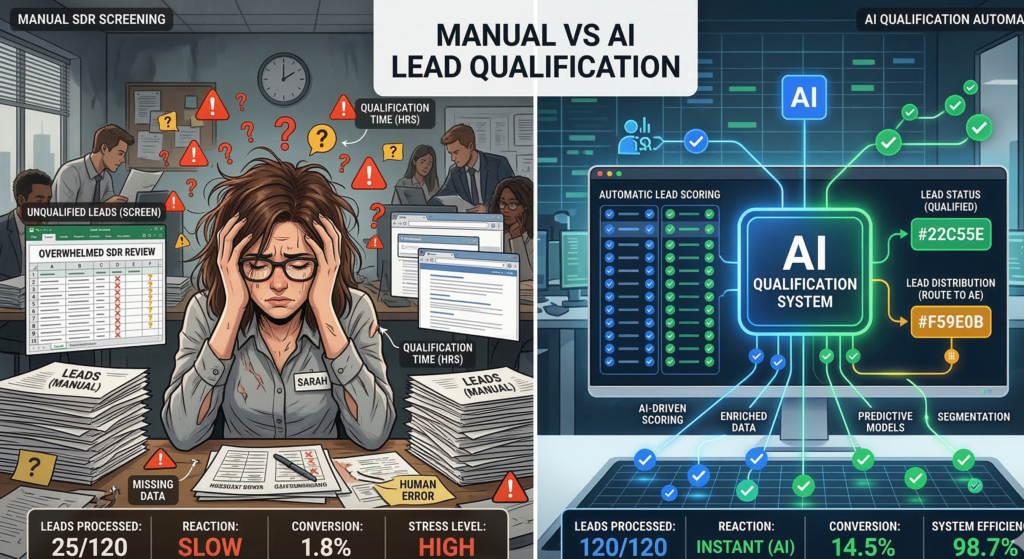
Traditionally, companies solve this problem by hiring Sales Development Representatives (SDRs) to screen leads manually. They call, email, ask qualifying questions, and decide whether a prospect should move forward in the pipeline.
The problem is scale.
A human SDR can only process a limited number of conversations per day, and their evaluation of buyer intent often varies depending on experience, fatigue, or timing. Valuable opportunities can sit untouched for hours—or disappear entirely.
This is where AI lead qualification fundamentally changes the economics of modern sales operations.
Instead of relying on manual screening, AI systems evaluate intent signals, analyze conversation patterns, score leads automatically, and route qualified prospects directly into the sales pipeline.
For sales leaders responsible for pipeline performance, the question is no longer whether automation will play a role in qualification.
The real question is how much revenue is currently lost because qualification happens too slowly.
What Is AI Lead Qualification?
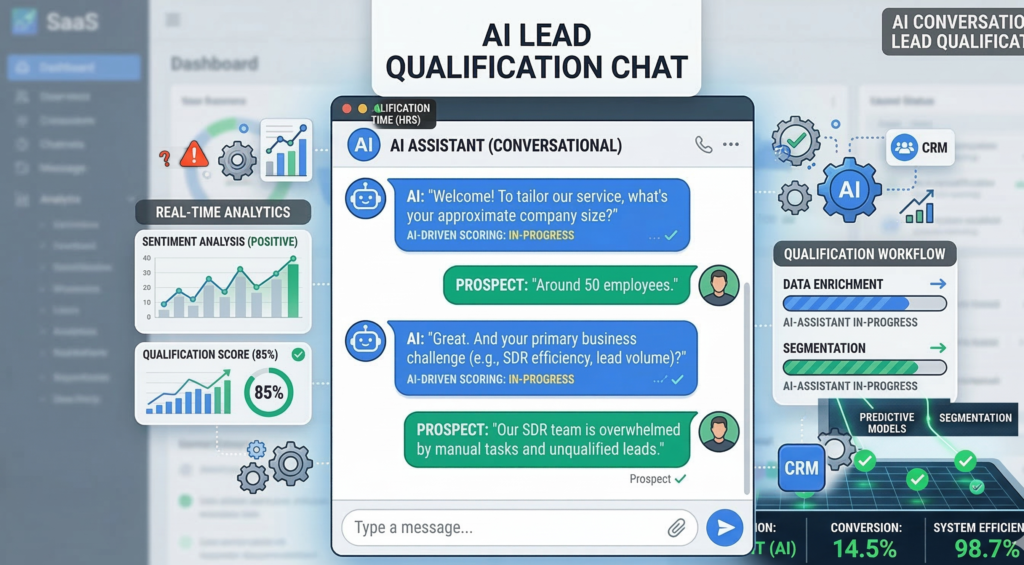
AI lead qualification is the process of using artificial intelligence to evaluate whether a prospect meets predefined sales criteria based on behavioral signals, conversation patterns, and engagement data.
Instead of relying on manual screening calls, AI systems analyze multiple inputs simultaneously, including:
- website behavior
- form responses
- email replies
- chat conversations
- CRM history
- demographic data
These signals allow the system to determine whether a lead demonstrates meaningful buying intent.
Definition for Featured Snippet
AI lead qualification uses machine learning and conversational AI to analyze lead behavior, intent signals, and engagement patterns to automatically determine whether a prospect should enter the sales pipeline. It replaces or augments manual screening traditionally performed by Sales Development Representatives.
Why Qualification Matters More Than Lead Volume
Many sales organizations focus heavily on lead generation metrics.
But lead generation without effective qualification creates hidden problems:
- overloaded SDR teams
- slow response times
- inconsistent qualification criteria
- lost high-intent opportunities
AI systems solve this by applying consistent evaluation logic across every inbound lead.
No fatigue.
No skipped follow-ups.
No missed intent signals.
Key takeaway: AI doesn’t replace qualification—it makes qualification consistent and scalable.
The Hidden Inefficiencies of Manual Sales Screening
Manual qualification has been the standard sales process for decades, but it carries structural inefficiencies that are difficult to eliminate.
SDR Capacity Limits
A typical SDR handles:
- inbound lead responses
- follow-up emails
- discovery calls
- CRM updates
Even highly efficient teams struggle to respond immediately to every new lead.
This creates a delay between lead interest and sales engagement.
Research across sales organizations consistently shows a simple pattern:
The longer the response delay, the lower the conversion rate.
Inconsistent Qualification Decisions
Human qualification introduces variability.
Two SDRs evaluating the same lead might reach different conclusions depending on:
- interpretation of answers
- experience level
- current workload
This inconsistency affects pipeline quality.
Some qualified buyers are rejected prematurely, while low-intent prospects occasionally slip through.
Administrative Overhead
SDRs also spend substantial time on tasks that are not directly related to selling:
- updating CRM records
- routing leads internally
- scheduling meetings
- documenting call outcomes
These activities consume hours that could otherwise be spent engaging qualified buyers.
Key takeaway: manual qualification struggles with scale, speed, and consistency.
Intent-Based Conversational AI: How AI Qualifies Leads in Real Time
The most powerful advancement in AI lead qualification comes from conversational systems that interact directly with prospects.
Instead of waiting for an SDR response, AI systems can engage leads immediately through:
- website chat
- SMS
- voice interactions
- email conversations
Real-Time Qualification Conversations
AI systems ask structured qualification questions such as:
- What problem are you trying to solve?
- What timeline are you working with?
- How large is your team?
- What system are you currently using?
But unlike static forms, conversational AI adapts dynamically based on responses.
For example:
A prospect mentioning budget approval signals stronger intent than someone researching general information.
AI models detect these signals and adjust lead scoring accordingly.
Pattern Recognition in Conversations
Beyond individual answers, AI evaluates conversation patterns such as:
- urgency indicators
- decision-maker involvement
- technical requirements
- competitor mentions
These patterns help determine sales readiness.
Key takeaway: conversational AI captures qualification data earlier in the buyer journey.
Automated Lead Scoring Algorithms
Lead scoring has existed for years in CRM systems, but traditional scoring models rely on simple rule sets.
AI-driven lead scoring models are far more sophisticated.
Traditional Lead Scoring
Most systems score leads using simple metrics such as:
- company size
- industry
- form completion
- email engagement
While useful, these signals don’t always correlate with buying intent.
AI-Based Lead Scoring Models
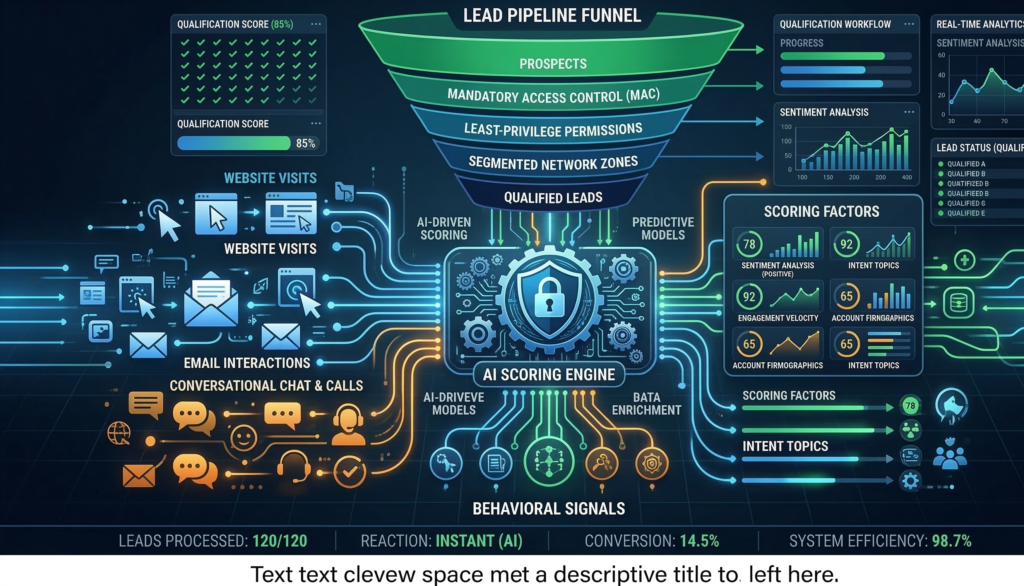
AI scoring models incorporate behavioral signals such as:
- interaction depth
- response speed
- question complexity
- conversation trajectory
- historical conversion patterns
These models improve over time as they observe which leads actually convert into revenue.
Revenue-Oriented Scoring
The ultimate goal of AI scoring isn’t just identifying interest.
It is predicting pipeline probability.
Instead of asking:
“Is this lead engaged?”
AI asks:
“Does this lead behave like past customers who eventually purchased?”
Key takeaway: AI scoring models evaluate intent, not just engagement.
Response Time Optimization: The Overlooked Conversion Driver
Speed is one of the most important factors in lead conversion.
Yet many organizations underestimate how quickly buyer interest fades.
The Attention Window Problem
When a prospect submits a form or asks a question, they are typically evaluating multiple vendors simultaneously.
If a company waits hours to respond, competitors may already be engaged in conversation.
AI solves this by enabling instant lead engagement.
Immediate Interaction
AI-powered systems can respond within seconds to:
- website inquiries
- demo requests
- inbound calls
- marketing campaign responses
This immediate interaction captures buyer attention while interest is highest.
Conversation Continuity
AI also maintains consistent follow-up:
- reminders
- qualification questions
- meeting scheduling
- information requests
No lead goes unanswered.
Key takeaway: response speed is often the difference between winning and losing opportunities.
CRM Integration: Turning Qualification into Pipeline Momentum
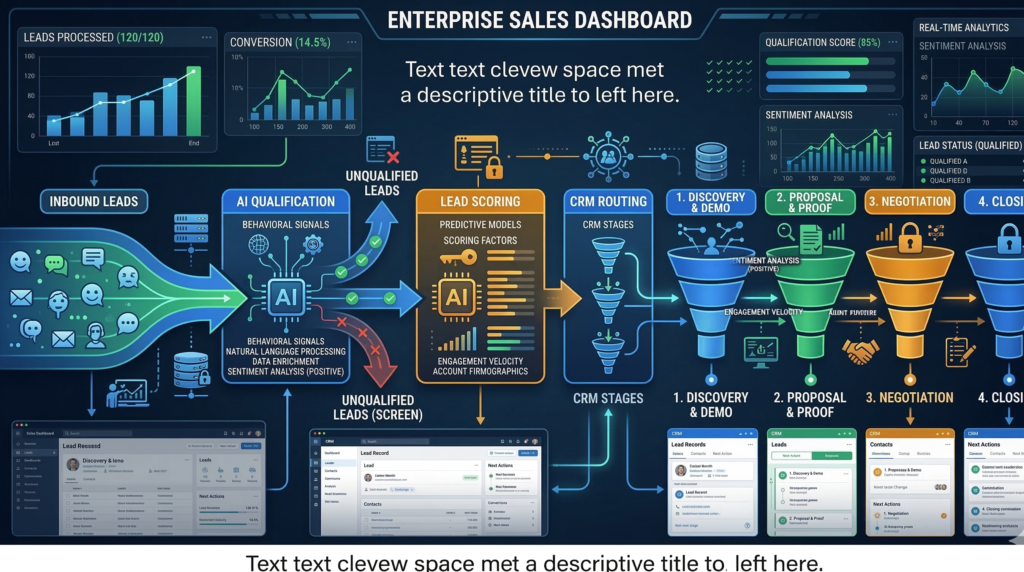
Qualification only becomes valuable when it connects directly to the sales pipeline.
This is where CRM integration plays a crucial role in AI sales automation.
Automatic Lead Routing
When AI systems identify a qualified prospect, they can automatically:
- create CRM records
- assign leads to the appropriate sales rep
- schedule meetings
- trigger follow-up sequences
This eliminates manual handoff delays.
Data Enrichment
AI qualification systems can also enrich CRM data with insights gathered during conversations:
- problem statements
- technical requirements
- timeline expectations
- budget indicators
Sales representatives start conversations with context instead of guesswork.
Pipeline Visibility
For sales directors, this integration improves pipeline clarity.
Instead of relying solely on manual notes from SDR calls, leaders can analyze structured data about:
- qualification outcomes
- conversation patterns
- conversion drivers
[INTERNAL LINK: How AI SDR Systems Transform Sales Outreach]
Key takeaway: CRM integration turns qualification insights into pipeline acceleration.
Revenue Impact: Modeling the ROI of AI Lead Qualification
Sales leaders ultimately evaluate technology through one lens:
revenue impact.
AI lead qualification influences revenue in multiple ways.
Higher Lead Response Speed
Immediate engagement increases the probability that prospects remain in conversation.
Improved Pipeline Quality
Better qualification ensures sales teams focus on prospects with genuine intent.
Increased SDR Productivity
AI handles early-stage conversations, allowing SDRs to focus on:
- complex discovery calls
- strategic outreach
- high-value accounts
Reduced Opportunity Loss
Perhaps the most overlooked benefit is preventing leads from disappearing due to slow follow-up.
In many organizations, a significant portion of inbound leads never receive meaningful engagement.
AI eliminates that gap.
[INTERNAL LINK: AI Sales Automation Strategy for Modern Revenue Teams]
Key takeaway: AI qualification improves revenue by accelerating response time and increasing pipeline precision.
Implementation Framework: AI Lead Qualification Readiness Checklist
Sales leaders considering AI qualification should evaluate readiness across five areas.
AI Lead Qualification Readiness Framework
1. Lead Volume
High inbound lead volume creates the strongest automation benefit.
2. Response Time Gaps
If leads wait hours or days for responses, automation will immediately improve conversion potential.
3. CRM Data Quality
AI systems rely on accurate pipeline data for scoring and routing.
4. Sales Process Definition
Clear qualification criteria improve AI decision accuracy.
5. Integration Infrastructure
The ability to connect AI systems with CRM, communication tools, and marketing platforms ensures smooth deployment.
Organizations scoring highly across these categories typically see the fastest ROI.
Key takeaway: successful adoption depends on aligning AI qualification with the existing sales process.
AI-Driven Lead Qualification in Modern Sales Operations
As sales teams scale, maintaining consistent qualification becomes increasingly difficult.
Automation solves this challenge by embedding qualification logic directly into the sales infrastructure.
Platforms like Aivorys (https://aivorys.com) are built for this operational model, combining conversational AI, voice automation, and CRM-connected workflows so businesses can evaluate and route inbound leads automatically while maintaining control over data handling and internal systems.
The advantage isn’t simply automation.
It’s predictable pipeline flow.
Sales leaders gain confidence that every inbound opportunity receives immediate attention and consistent evaluation.
Key takeaway: AI qualification transforms lead screening from a manual task into an automated sales infrastructure layer.
FAQ SECTION
What is AI lead qualification?
AI lead qualification uses artificial intelligence to analyze prospect behavior, engagement signals, and conversations to determine whether a lead is likely to convert into a customer. It automates the early screening process traditionally handled by SDRs.
How does AI lead scoring differ from traditional lead scoring?
Traditional lead scoring relies on simple rule-based metrics such as job title or form completion. AI lead scoring evaluates behavioral patterns, engagement signals, and historical conversion data to predict which prospects are most likely to become customers.
Can AI replace human SDRs?
AI is most effective when augmenting SDR teams rather than replacing them. Automation handles early-stage qualification and routine questions, allowing SDRs to focus on deeper discovery conversations and complex sales opportunities.
How quickly can AI respond to inbound leads?
AI systems can respond instantly to inbound inquiries across chat, email, voice, or messaging channels. This immediate engagement significantly improves the chances of converting interested prospects into qualified sales opportunities.
Does AI lead qualification integrate with CRM systems?
Yes. Modern AI qualification systems integrate with CRM platforms to automatically create lead records, assign prospects to sales representatives, and capture insights from qualification conversations.
Is AI lead qualification only useful for large companies?
Not at all. Small and mid-sized companies often benefit significantly because AI allows them to respond to every inbound lead without expanding SDR headcount.
Conclusion
Sales organizations spend enormous resources generating leads.
But revenue doesn’t come from lead generation alone—it comes from identifying which leads are ready to buy and engaging them at the right moment.
Manual qualification struggles to keep pace with modern buying behavior. Prospects expect immediate responses, personalized conversations, and frictionless scheduling.
AI lead qualification closes that gap.
By analyzing intent signals, engaging prospects instantly, and routing qualified opportunities directly into the pipeline, AI transforms lead screening from a manual bottleneck into a scalable sales infrastructure.
For sales leaders responsible for pipeline growth, the opportunity isn’t simply improving efficiency.
It’s ensuring that no serious buyer waits long enough to lose interest.