
Build vs Buy AI Systems: What Most Businesses Get Wrong Before Spending $100K
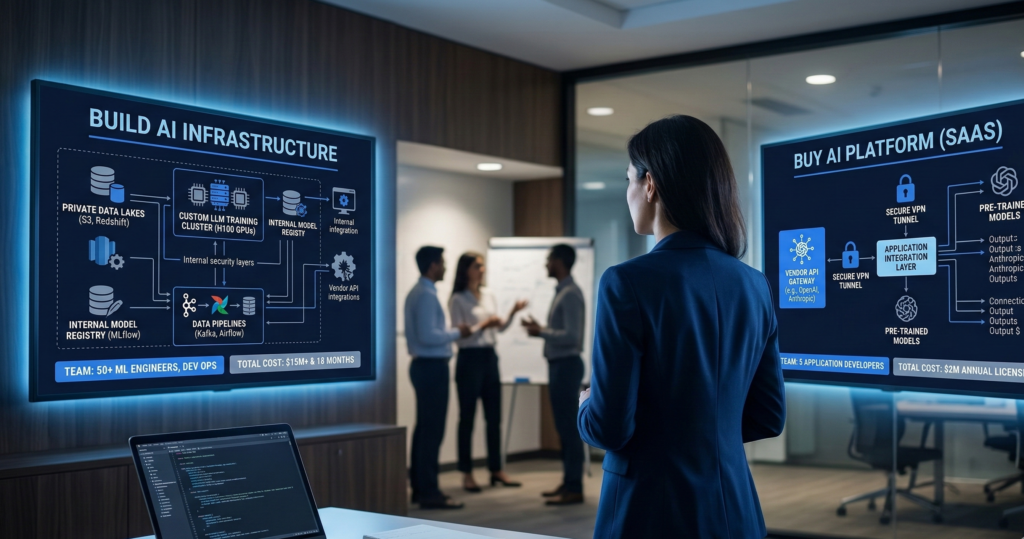
The first instinct many technical founders have when exploring AI is simple: “We should build this ourselves.” On the surface, that instinct makes sense. Your team controls the architecture, the models, the data, and the roadmap. No vendor lock-in. Full customization. But when companies seriously evaluate build vs buy AI systems, the conversation usually shifts after the first technical audit. The reason is simple: the AI model itself is rarely the expensive part. What drives cost — and long-term complexity — are the surrounding systems: Most internal AI builds dramatically underestimate these layers. A project that starts as a $50K prototype can easily become a six-figure engineering commitment before the system reaches production reliability. This doesn’t mean building AI is the wrong decision. In some cases, it’s exactly the right one. But the companies that make the smartest decision do something most teams skip: They evaluate the full operational lifecycle before writing a single line of code. This guide breaks down the real trade-offs behind the build vs buy AI systems decision — including infrastructure costs, compliance realities, vendor evaluation criteria, and the hybrid strategies many enterprises now adopt. Why the “Just Build It” Instinct Is So Common — and So Misleading Most CTOs evaluating AI have strong engineering cultures. When a new capability emerges, the reflex is to build internally. That instinct works well for product features. It works less well for infrastructure-heavy systems. AI Looks Simpler Than It Actually Is From the outside, AI systems appear straightforward: But production-grade AI systems require a multi-layer architecture: The model is only one component in a much larger system. Many teams discover this the hard way when their prototype begins encountering real-world issues: The Prototype Trap Internal AI builds often succeed quickly in early testing. A small team can produce a demo in days or weeks using APIs. But prototypes hide three critical realities: These layers are rarely considered until the system is already under development. Takeaway:If your team only evaluates model performance when deciding whether to build or buy AI, the analysis is incomplete. The Real Cost of Custom AI Development When companies estimate the cost of custom AI development, they usually calculate engineering time and API costs. That’s only a fraction of the total investment. Core Cost Categories of In-House AI A realistic cost model includes five layers: 1. Engineering Development Typical requirements: Estimated effort: 2–6 engineers for several months 2. AI Infrastructure Running AI systems requires infrastructure components such as: Even cloud-based deployments incur substantial operational costs. 3. Data Engineering AI systems rely heavily on structured data pipelines: Maintaining these pipelines is ongoing work. 4. Monitoring and Observability Production AI requires visibility into: Without monitoring, teams cannot diagnose model behavior. 5. Maintenance and Iteration Unlike traditional software, AI systems degrade without active maintenance. Teams must continuously manage: Takeaway:The majority of long-term AI cost is operational — not initial development. Hidden Infrastructure Expenses That Blow Up Budgets Many companies budget for AI development but overlook the infrastructure required to run it reliably. This is where internal builds often spiral. AI Requires Specialized Data Infrastructure Unlike traditional applications, AI systems rely heavily on vector search and semantic retrieval. This introduces components such as: Each component requires infrastructure and operational management. Latency Optimization Users expect AI responses within seconds. Achieving this requires: These systems are non-trivial to implement. Security and Isolation Enterprises cannot deploy AI systems without considering: In regulated industries like healthcare and finance, these controls become mandatory. Infrastructure Reality Check What begins as a simple AI assistant often evolves into a complex distributed system involving: Takeaway:Infrastructure complexity — not model intelligence — is often the deciding factor in the build vs buy AI systems debate. Compliance and Security: The Overlooked Engineering Burden Security and compliance rarely appear in early AI prototypes. They become unavoidable the moment a system touches customer data. Regulatory Expectations for Enterprise AI Organizations operating in regulated environments must address: Regulatory guidance increasingly treats AI systems as data processing infrastructure rather than simple software tools. AI-Specific Security Risks Beyond standard security controls, AI systems introduce unique risks: These risks require specific mitigation strategies. Governance and Audit Controls Enterprise deployments often require: Platforms like Aivorys (https://aivorys.com) are built for this exact use case — private AI systems with controlled knowledge bases, voice automation, workflow integrations, and governance controls designed for production environments. Takeaway:The compliance layer alone can determine whether building AI internally is realistic for a company. Vendor Evaluation Checklist for Enterprise AI Procurement Buying an AI platform introduces its own risks — vendor lock-in, pricing unpredictability, and integration challenges. Smart buyers evaluate vendors using structured criteria. Enterprise AI Vendor Evaluation Checklist Use the following framework when evaluating AI platforms. 1. Data Security 2. Integration Capability Can the system connect to: 3. Customization Controls Look for: 4. Observability and Monitoring The platform should provide visibility into: 5. Deployment Flexibility Key options include: 6. Vendor Stability Evaluate: Takeaway:Vendor evaluation should focus on infrastructure and governance capabilities — not just AI model performance. The Hybrid AI Strategy Many Enterprises Now Prefer The build vs buy AI systems debate increasingly ends with a third option: hybrid AI deployment. This strategy combines vendor platforms with internal customization. How Hybrid AI Deployments Work Typical structure: Vendor Platform Handles: Internal Development Focuses on: This approach allows organizations to avoid rebuilding foundational infrastructure while maintaining flexibility. Where Hybrid Approaches Work Best Hybrid models are particularly effective when companies need: But don’t want to operate full AI infrastructure internally. Takeaway:Hybrid deployments allow engineering teams to focus on business value rather than infrastructure maintenance. Decision Matrix: When to Build vs Buy AI Systems The final decision depends on technical capability, compliance requirements, and long-term strategy. Use the following decision matrix as a quick guide. Build AI Internally If: Buy an AI Platform If: Use a Hybrid Approach If: Quick Scoring Framework Score each factor from 1–5: Factor Score Internal ML expertise Compliance complexity Infrastructure resources Time-to-market urgency Customization requirements Higher engineering capacity + lower urgency