
On-Premise AI vs Private Cloud AI: Data Protection Guide
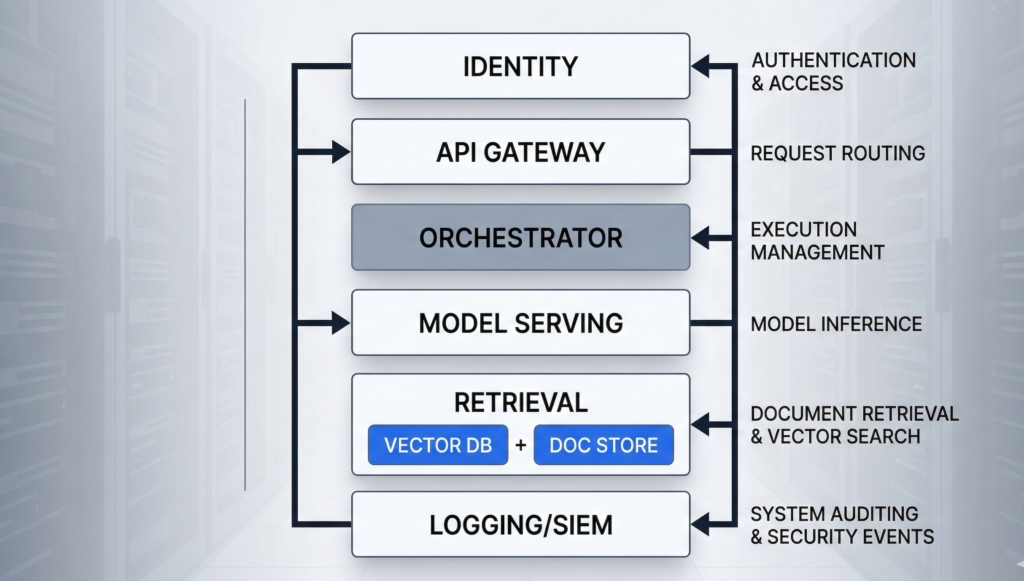
A procurement team wants “AI in 90 days.” Legal asks where prompts are stored. Security asks who can retrieve embeddings. Compliance asks for retention, audit logs, and data residency. And your infrastructure team asks the question that actually decides everything: on-premise AI vs private cloud AI — which deployment model keeps company data under control when the system is under pressure? Most articles answer this like it’s a hosting preference. It isn’t. Deployment model changes your trust boundaries: where data can flow, who can administer it, what gets logged, and how quickly you can prove compliance when an incident or audit hits. This guide breaks the decision down the way infrastructure teams actually evaluate it: architecture, identity and access, key management, observability, regulatory scope, operational maturity, and failure modes. You’ll get a practical rubric you can use in an internal review, plus a checklist you can hand to your security and compliance stakeholders without triggering a week of back-and-forth. H2: What “protects data” actually means in enterprise AI When leaders ask which option “protects data,” they’re usually bundling several requirements into one word. Separate them, and the tradeoffs become concrete. Data protection in enterprise AI typically means: The misconception: people treat “cloud” as inherently less secure or “on-prem” as inherently safer. In practice, the riskiest systems are the ones with unclear boundaries: shared admin accounts, undocumented egress, no prompt/output logging policy, and no change control over prompts and retrieval. Actionable takeaway: Before you compare AI deployment models, write a one-page “data protection definition” for your program: the data types involved, allowed storage forms, required logs, retention windows, and who must approve changes. If you can’t define this, no deployment model will save you. H2: On-premise AI architecture — what you control (and what you inherit) On-premise AI usually means the core components run in your own data center or dedicated facilities: model serving (GPU/CPU), retrieval (vector database + document store), orchestration, identity integration, logging, and monitoring. The real benefit is control over the full stack—especially the last mile of data handling. What on-prem gives you: What on-prem makes you responsible for: The under-discussed failure mode: “on-prem” systems often drift into security debt because upgrades are hard, GPU stacks are fragile, and teams postpone patches. That creates a slow-moving risk that is easy to ignore until the first incident. Actionable takeaway: If you choose on-prem, require an operational plan upfront: patch cadence, image hardening baseline, log retention, admin access model, and a quarterly restore test. Treat it like a product, not a server rack. H2: Private cloud AI explained — isolation, controls, and the real trust boundary Private cloud AI isn’t “public cloud with a nicer name.” The security posture depends on whether you’re getting a logically isolated environment with private networking, hardened IAM, and auditable controls—or simply hosting workloads in a standard tenant with better marketing language. A strong private cloud deployment for enterprise AI commonly includes: Where private cloud often wins: operational rigor. Many organizations can enforce least privilege, collect logs, and roll out updates faster in cloud environments because the primitives are mature and integration patterns are standardized. Where it can lose: unclear administrative access paths. If your threat model includes powerful cloud admin roles, vendor support access, or misconfigured cross-account permissions, “private cloud” can still allow data exposure—just through different doors. The practical framing: private cloud reduces certain risks (drift, inconsistent logging, slow patching) and increases others (control plane dependency, cloud IAM complexity). Security becomes an IAM and governance discipline problem. Actionable takeaway: Ask one question early: “Can we prove—through logs and policy—that no human can access production prompts and retrieval data without an auditable break-glass event?” If the answer is vague, your private cloud is not yet “private” in the way compliance expects. H2: Compliance and audit readiness — evidence beats architecture slogans Regulated environments don’t reward good intentions. They reward evidence: documented controls, consistent enforcement, and audit trails that stand up to scrutiny. Whether you deploy on-prem or private cloud, auditors and internal risk teams usually want proof of: Where on-prem can be stronger: when regulations or internal policy require strict data locality and you need full control over storage, backups, and log retention with no external dependency. Where private cloud can be stronger: when your organization needs standardized evidence across environments—centralized logs, policy enforcement, and repeatable infrastructure builds that generate consistent artifacts. Common compliance trap: teams focus on where the model runs and ignore the surrounding data flows—CRM connectors, call recordings, transcription pipelines, analytics exports, and support tooling. Most “AI data leaks” happen in the integration layer, not inside the model. Actionable takeaway: Build your “audit evidence map” before buildout: for each control (access, change, retention, encryption), specify (1) where evidence is logged, (2) who reviews it, and (3) how long it’s retained. Choose the deployment model that makes this easiest to execute reliably. H2: Cost, scalability, and latency — the tradeoffs that quietly change risk Security decisions get reversed later when the system can’t meet real-world performance requirements. That’s why cost, scalability, and latency are not separate from data protection—they influence architecture decisions that determine where data ends up flowing. Latency (especially for voice AI): Scalability: Cost: The risk link: when teams can’t scale safely, they introduce shortcuts—public endpoints “temporarily,” shared admin accounts “for speed,” or exporting data to third-party tools “just to debug.” Those shortcuts become the real breach path. Actionable takeaway: Treat performance constraints as security requirements. Document concurrency expectations, acceptable latency thresholds, and data flow boundaries under load. Then choose the deployment model that meets those requirements without “temporary” exceptions. H2: Hybrid AI models for regulated industries — isolate what must be isolated Many enterprise environments don’t have a single “right” answer because different data classes have different constraints. Hybrid deployment solves this by placing the strictest data inside the strictest boundary, while keeping the rest of the system operationally efficient. A common hybrid pattern looks like this: Why hybrid works: it aligns “where the data lives” with “how