
The Hidden Cost of Your Lettuce: Child Labor & the Rise of Farm Automation
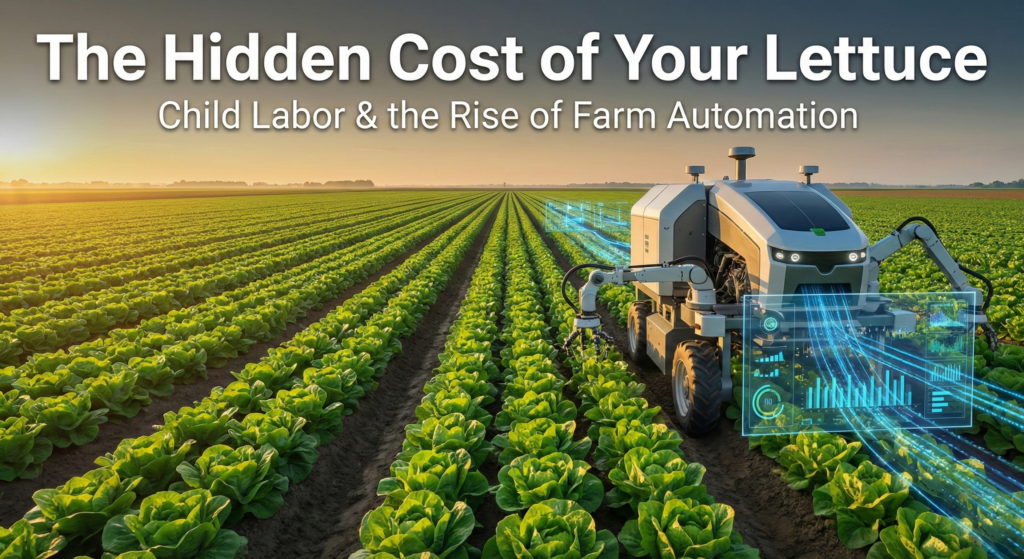
Introduction — A Quiet Truth Beneath the Leaves The video opens with a haunting question: “You ever look at a head of lettuce and think… a ten-year-old probably picked this?”It’s not an exaggeration, not a metaphor, not a distant crisis.It’s the uncomfortable reality hiding in plain sight — in grocery aisles, supply chains, and the soil of American fields. For decades, U.S. agriculture depended on immigrant adults performing strenuous, poorly paid work. But now, something far darker has crept in: children are being pulled into the labor vacuum, quietly replacing adults in one of the most physically punishing industries in the country. This isn’t happening overseas.It’s happening here.On American soil.Inside billion-dollar supply chains. And the narrator’s voice trembles not with fear — but with urgency. Conflict — A System Built on Desperation The media blames a “labor shortage,” but the video pulls back the curtain to reveal a truth far more unsettling. Instead of raising wages or investing in innovation, many farms are hiring children — 12-year-olds, 14-year-olds, working under the burning heat for ten-hour shifts. Thousands of migrant kids, according to major reports, are funneled into these jobs because they are easy to exploit. They don’t push back. They can’t. Adults — once the backbone of farm labor — are being pushed out, simply because a child is cheaper. This isn’t an accident.It’s not isolated.It’s systemic. Today, over 300,000 children work in U.S. agriculture. Some are paid poorly. Some aren’t paid at all. Many handle sharp tools, hazardous machinery, and chemicals with zero training. The cost savings are real.But so is the damage — broken bones, broken education, broken futures. All so lettuce can be 15 cents cheaper. The narrator makes it painfully clear: this is not an attack on farmers — it’s an attack on an outdated system that punishes the vulnerable because it refuses to modernize. Turning Point — The Myth of “Automation Is Too Expensive” Then comes the pivot. For years, industries have defended these labor practices by claiming: “Automation costs too much.”But when compared to the legal risks, exploitation, and inefficiencies of child labor, the excuse rings hollow. The video sweeps through example after example: The technology isn’t futuristic.It’s not experimental.It’s already deployed in California, Florida, Spain, Japan. Automation isn’t “coming.”It’s here — proven, affordable, scalable. And with every passing day of hesitation, another child loses a year of school, a piece of health, a slice of their future. Resolution — A Smarter, Ethical Way Forward Automation isn’t a threat to workers — it’s a lifeline. It doesn’t eliminate people.It elevates them. With robotic harvesting and voice-driven AI coordination, humans take on roles of oversight, maintenance, and skill-building — work that creates careers instead of cutting them short. And for business owners, the benefits are impossible to ignore: Companies that exploit labor eventually collapse under scandal.Companies that innovate rise above the noise. Because in the end, the market rewards what is smart, sustainable, and ethical. Final Message — The Call to Upgrade The narrator introduces AIvorys — a system designed to remove chaos from labor operations using AI voice agents that coordinate crews, automate logistics, and reduce reliance on vulnerable workers. The message is powerful and unapologetic: “If your business still runs on child labor in 2025, it’s not a business.It’s a moral liability.” Automation isn’t charity.It’s strategy.It’s how industries grow without losing their integrity. The video ends with a call to action — not just to click and subscribe, but to choose the better model, the one where success isn’t built on the backs of exploited children but on innovation, intelligence, and humanity. 🔍 Key Insights & Takeaways Emotional Highlights Core Ideas Memorable Lines / Core Messages