
Video Summary — “The Hidden Cost of Manual Work in Mexico’s Expat Service Industry
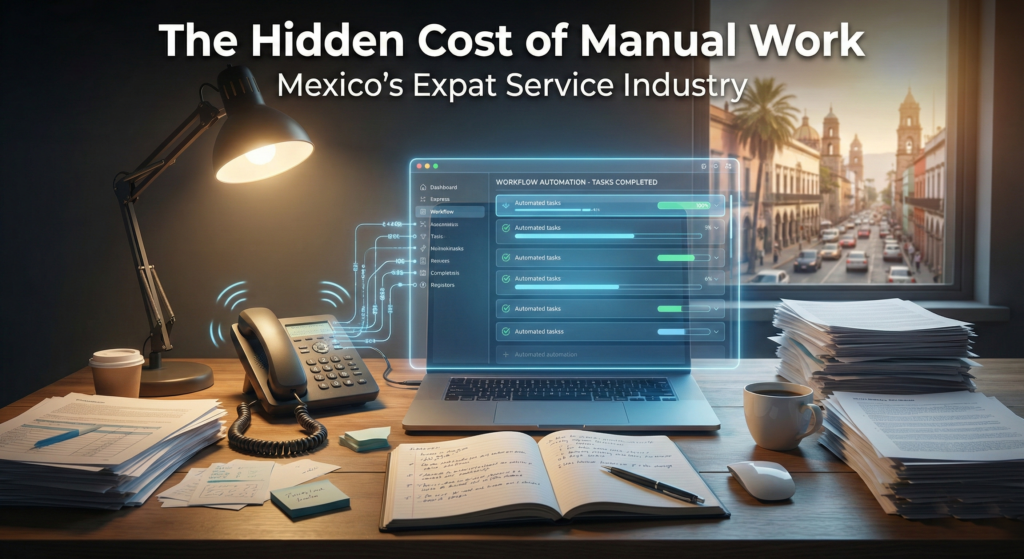
In this gripping and brutally honest narrative, the video opens with a question that hits like a lightning strike — why are hardworking Mexican businesses serving expats grinding for ten hours a day and still earning scraps? From the first moment, we’re pushed into a world where effort and income are painfully out of sync. The expats spend freely, the demand is high, yet the businesses serving them remain trapped in a cycle of burnout, inefficiency, and outdated systems that drain time, energy, and profit. I. The Quiet Crisis Beneath the Hustle The script paints a vivid picture of the daily struggle: endless WhatsApp messages, repetitive FAQs, manual quotes, invoices typed out like it’s still the late ’90s, and a constant chase for payments. It’s not laziness. It’s not lack of opportunity. It’s a storm of low-value tasks swallowing entire workdays — a hidden enemy stealing nearly 40% of a business’s income without anyone noticing. The emotional core becomes clear: these businesses don’t have a sales problem — they have an efficiency problem. And worse, no one ever told them. II. A Hard Truth — and a Turning Point As the narrative unfolds, the video exposes a truth that feels both uncomfortable and liberating:Mexican businesses serving expats could triple their profits if they stopped doing work that should have been automated long ago. While hardworking owners drown in administrative chaos, competitors using simple automation tools grow faster, serve more clients, and make more money with fewer hours. The contrast is sharp — almost painful — and meant to spark a wake-up call. III. The Math of Freedom The script anchors the story in real numbers:A business making 50,000 pesos a month is unknowingly burning 30–40% of it on inefficiency. Every hour spent answering the same message…Every repetitive quote…Every manually booked reservation……is another cut in a thousand-cut death. Automation, the video explains, isn’t about fancy tech or Silicon Valley dreams. It’s about multiplying output without multiplying exhaustion. About reclaiming time, reducing errors, and unleashing humans to do what actually grows the business: selling, upselling, and delivering unforgettable experiences. IV. The Hero Arrives — AIVorys Then comes the turning point — the introduction of AIVorys, not as a gadget, not as software, but as a tireless digital teammate built specifically for Mexican businesses serving expats. It doesn’t ask for English.It doesn’t require coding.It doesn’t break the bank. It simply works. Whether it’s automating WhatsApp quotes, confirming bookings, sending invoices and reminders, or answering FAQs, AI Vory steps in as the silent worker who never sleeps, never complains, and never drops the ball. A system designed in Spanish, built for real businesses, and engineered to remove the operational pain that has held so many back. V. The Call to Transformation The video closes with an empowering yet urgent message:If a business continues doing everything manually, it isn’t just wasting time — it is bleeding profit.The winners are the ones who automate the boring tasks and free their minds, their teams, and their income to grow. Automation is no longer luxury.It’s survival.And for those ready to step into a future of freedom, profits, and peace of mind — AI Vory stands ready to help. 🔍 Key Insights & Core Messages
Video Summary — “The Hidden Cost of Your Lettuce: Child Labor & the Rise of Farm Automation”
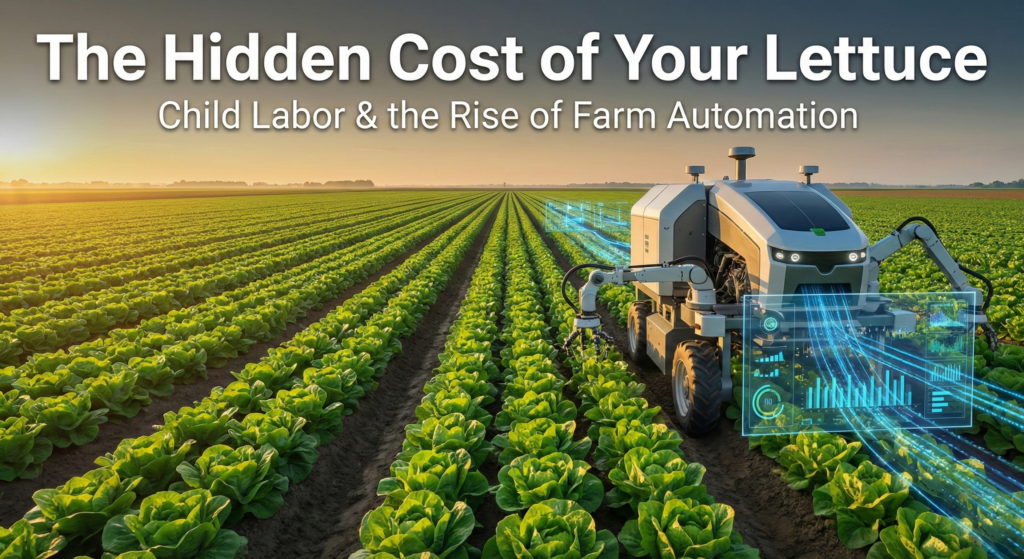
Introduction — A Quiet Truth Beneath the Leaves The video opens with a haunting question: “You ever look at a head of lettuce and think… a ten-year-old probably picked this?”It’s not an exaggeration, not a metaphor, not a distant crisis.It’s the uncomfortable reality hiding in plain sight — in grocery aisles, supply chains, and the soil of American fields. For decades, U.S. agriculture depended on immigrant adults performing strenuous, poorly paid work. But now, something far darker has crept in: children are being pulled into the labor vacuum, quietly replacing adults in one of the most physically punishing industries in the country. This isn’t happening overseas.It’s happening here.On American soil.Inside billion-dollar supply chains. And the narrator’s voice trembles not with fear — but with urgency. Conflict — A System Built on Desperation The media blames a “labor shortage,” but the video pulls back the curtain to reveal a truth far more unsettling. Instead of raising wages or investing in innovation, many farms are hiring children — 12-year-olds, 14-year-olds, working under the burning heat for ten-hour shifts. Thousands of migrant kids, according to major reports, are funneled into these jobs because they are easy to exploit. They don’t push back. They can’t. Adults — once the backbone of farm labor — are being pushed out, simply because a child is cheaper. This isn’t an accident.It’s not isolated.It’s systemic. Today, over 300,000 children work in U.S. agriculture. Some are paid poorly. Some aren’t paid at all. Many handle sharp tools, hazardous machinery, and chemicals with zero training. The cost savings are real.But so is the damage — broken bones, broken education, broken futures. All so lettuce can be 15 cents cheaper. The narrator makes it painfully clear: this is not an attack on farmers — it’s an attack on an outdated system that punishes the vulnerable because it refuses to modernize. Turning Point — The Myth of “Automation Is Too Expensive” Then comes the pivot. For years, industries have defended these labor practices by claiming: “Automation costs too much.”But when compared to the legal risks, exploitation, and inefficiencies of child labor, the excuse rings hollow. The video sweeps through example after example: The technology isn’t futuristic.It’s not experimental.It’s already deployed in California, Florida, Spain, Japan. Automation isn’t “coming.”It’s here — proven, affordable, scalable. And with every passing day of hesitation, another child loses a year of school, a piece of health, a slice of their future. Resolution — A Smarter, Ethical Way Forward Automation isn’t a threat to workers — it’s a lifeline. It doesn’t eliminate people.It elevates them. With robotic harvesting and voice-driven AI coordination, humans take on roles of oversight, maintenance, and skill-building — work that creates careers instead of cutting them short. And for business owners, the benefits are impossible to ignore: Companies that exploit labor eventually collapse under scandal.Companies that innovate rise above the noise. Because in the end, the market rewards what is smart, sustainable, and ethical. Final Message — The Call to Upgrade The narrator introduces AIvorys — a system designed to remove chaos from labor operations using AI voice agents that coordinate crews, automate logistics, and reduce reliance on vulnerable workers. The message is powerful and unapologetic: “If your business still runs on child labor in 2025, it’s not a business.It’s a moral liability.” Automation isn’t charity.It’s strategy.It’s how industries grow without losing their integrity. The video ends with a call to action — not just to click and subscribe, but to choose the better model, the one where success isn’t built on the backs of exploited children but on innovation, intelligence, and humanity. 🔍 Key Insights & Takeaways Emotional Highlights Core Ideas Memorable Lines / Core Messages