

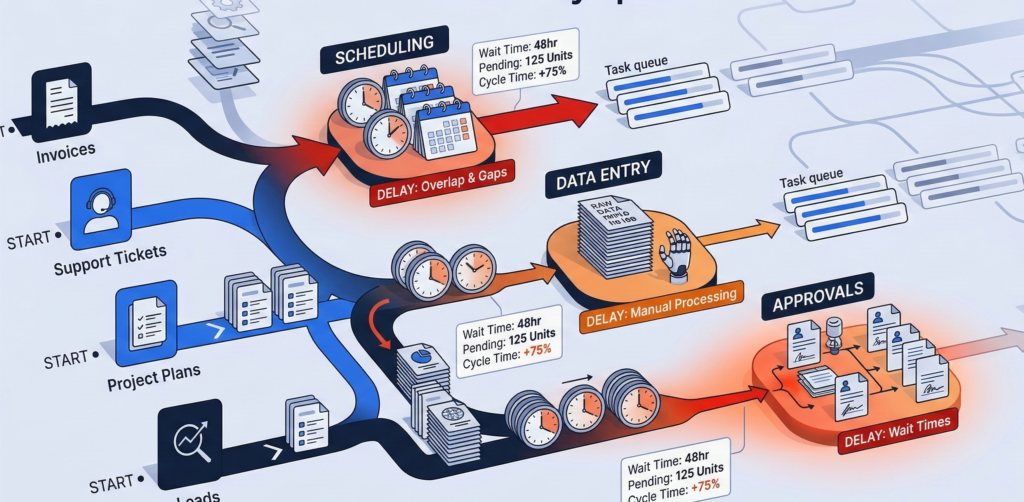
Operations teams rarely struggle because of strategy.
They struggle because of process friction.
A missed intake form.
A scheduling backlog.
A CRM record that never gets updated.
A lead that waits hours for a response.
Individually, these issues look small. But collectively they slow down revenue, create staff burnout, and make scaling operations painfully inefficient.
Most organizations try to solve this by hiring more people. The result is predictable: higher costs, more complexity, and the same operational drag.
The reality is that many of these bottlenecks share a common trait: they are predictable, rule-based, and repetitive. That makes them ideal candidates for AI workflow automation.
When deployed correctly, AI doesn’t just speed up tasks. It restructures operational workflows—automating intake, scheduling, data entry, routing, and follow-ups across systems.
This guide breaks down exactly where operational bottlenecks hide, how AI workflow automation removes them, and how operations leaders can identify the highest-impact automation opportunities inside their own processes.
Why Most Operational Bottlenecks Are Perfect Candidates for AI Workflow Automation
Operations leaders often assume automation requires complex decision-making or advanced AI reasoning.
In practice, the opposite is true.
Most operational bottlenecks stem from high-volume processes governed by simple rules.
Examples include:
- Scheduling appointments
- Routing inquiries
- Capturing lead information
- Updating CRM records
- Sending reminders and follow-ups
- Processing internal requests
These tasks may involve multiple systems, but their logic is straightforward.
If a lead submits a form → create a CRM entry → schedule a call → send confirmation → notify the sales team.
Humans perform these tasks today, but they do so slowly, inconsistently, and at a higher cost.
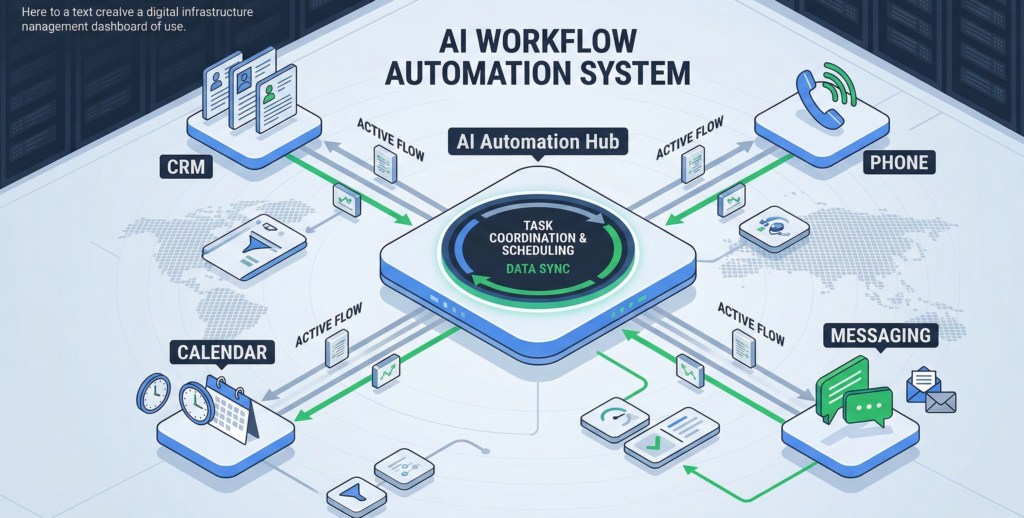
AI workflow automation replaces these manual handoffs with automated orchestration between systems.
The Key Characteristics of Automatable Operations
Workflows that benefit most from automation share several attributes:
1. Repetition
Tasks occur dozens or hundreds of times per day.
2. Predictable logic
Decisions follow clear rules rather than subjective judgment.
3. Multi-system coordination
Workflows move between tools like CRM, scheduling systems, spreadsheets, and messaging platforms.
4. Time sensitivity
Delays directly impact revenue or customer experience.
Operational takeaway:
If a process repeats frequently and follows predictable logic, AI workflow automation is usually the fastest path to operational improvement.
Identifying High-Cost Repetitive Workflows Inside Operations
Before implementing automation, operations leaders must identify where friction is actually occurring.
A useful exercise is to map workflows using a “time × frequency” analysis.
Instead of asking which tasks are annoying, ask:
- Which tasks consume the most cumulative staff time?
- Which workflows happen hundreds of times per month?
- Where do delays cause revenue loss?
The combination of frequency and time cost exposes the highest-value automation opportunities.
Common Operational Workflows That Drain Productivity
Across industries, several workflows consistently appear near the top of the list:
Lead intake and routing
New inquiries must be captured, categorized, and assigned.
Appointment scheduling
Calendar coordination between customers, staff, and availability rules.
CRM updates
Notes, contact records, and status changes that staff often forget to log.
Follow-up communication
Confirmations, reminders, and post-interaction messages.
Internal request routing
Requests between departments such as operations, finance, or support.
These workflows may appear trivial individually. Yet collectively they absorb significant operational capacity.
Research on workplace productivity consistently shows that knowledge workers spend large portions of their day coordinating work rather than performing it.
Operational takeaway:
Document operational workflows and calculate the total time consumed monthly. The processes with the highest cumulative hours are prime candidates for automation.
AI-Driven Scheduling and Intake Automation
Scheduling and intake processes are among the most operationally disruptive bottlenecks.
They appear simple. But behind the scenes they involve multiple coordination steps:
- Capturing information
- Validating availability
- Scheduling appointments
- Sending confirmations
- Logging records in internal systems
When humans manage these workflows manually, errors and delays accumulate quickly.
How AI Workflow Automation Handles Scheduling
AI automation can manage scheduling through a structured workflow:
Step 1: Capture request
Intake forms, phone conversations, or chat interactions gather structured information.
Step 2: Validate request
Rules determine service type, urgency, or department routing.
Step 3: Check availability
Calendar systems are queried automatically.
Step 4: Schedule appointment
The system confirms an available slot.
Step 5: Record the interaction
CRM entries and internal records are updated instantly.
Step 6: Send confirmations
Automated email or SMS notifications are triggered.
This entire sequence can occur in seconds.
The Operational Impact
The difference is not merely speed.
Automation produces consistent execution.
No missed entries.
No forgotten confirmations.
No delayed responses.
Operational takeaway:
Scheduling and intake workflows are often the first automation opportunities operations teams should evaluate because they directly influence customer response times.
Integrating AI Automation with CRM and Operational Systems
Automation fails when it operates in isolation.
True operational improvement requires integration with the systems teams already use.
That typically includes:
- CRM platforms
- Google Sheets or internal databases
- Phone systems
- Messaging tools
- scheduling software
AI workflow automation acts as the coordination layer between these tools.
Example Workflow Integration
Consider a typical operational sequence:
- Customer calls or submits a form
- AI captures details
- CRM contact record is created
- Lead source and service type are tagged
- Appointment is scheduled
- Confirmation messages are sent
- Internal teams receive notifications
Without integration, staff must manually perform each of these steps.
With automation, the workflow executes automatically across systems.
Platforms like Aivorys (https://aivorys.com) are designed for this type of orchestration—combining private AI knowledge systems, voice automation, and CRM-connected workflows so operational tasks move between tools without manual intervention.
Operational takeaway:
When evaluating automation tools, focus less on the AI model itself and more on how well the platform integrates with your operational stack.
Admin Task Reduction: The Hidden Productivity Multiplier

Operational teams often underestimate how much time administrative work consumes.
Admin tasks rarely appear on performance dashboards, yet they quietly dominate the workday.
Examples include:
- Data entry
- Record updates
- Appointment confirmations
- Internal coordination
- Status reporting
These activities do not directly create revenue.
But they are required to keep operations functioning.
Why Admin Work Scales Poorly
As organizations grow, administrative tasks multiply faster than core activities.
More customers means:
- more scheduling
- more records
- more follow-ups
- more coordination
Without automation, companies eventually solve this by hiring more administrative staff.
That increases cost without improving operational speed.
Automation changes the equation.
AI workflow automation handles the coordination layer, allowing employees to focus on work that requires human judgment.
Example Productivity Shift
A typical service organization might have staff spending hours each day:
- scheduling appointments
- updating CRM records
- sending confirmations
- routing internal requests
When those steps are automated, the same team can handle significantly higher operational volume.
Operational takeaway:
Admin automation rarely eliminates roles. Instead, it reclaims staff capacity, allowing operations teams to scale without proportional hiring.
Change Management: Why Automation Projects Fail
The technical side of automation is rarely the hardest part.
Adoption is.
Operations teams often resist automation for understandable reasons:
- fear of job displacement
- distrust of automated systems
- uncertainty about new workflows
Ignoring these concerns can derail even well-designed automation projects.
Three Change Management Principles
1. Start with visible pain points
Automate processes that employees already find frustrating.
2. Demonstrate reliability early
Small wins build trust in automation systems.
3. Keep humans in the loop
Escalation paths ensure complex cases are handled appropriately.
When teams see automation reducing tedious work rather than replacing them, adoption improves dramatically.
Operational takeaway:
Treat automation initiatives as organizational change projects, not just technology deployments.
A Practical Framework for Building an AI Workflow Automation Roadmap
Most organizations approach automation randomly—automating whatever seems easiest first.
A better approach uses a structured evaluation model.
The Workflow Automation Impact Score
Evaluate candidate workflows using five criteria:
| Criteria | Question | Score (1–5) |
|---|---|---|
| Frequency | How often does this process occur? | |
| Time Cost | How much staff time does it consume? | |
| Revenue Impact | Does delay affect revenue or customer experience? | |
| Process Clarity | Are the rules clearly defined? | |
| Integration Feasibility | Can the workflow connect to existing systems? |
Add the scores together.
Workflows scoring 18–25 are strong automation candidates.
Example Evaluation
Lead intake workflow:
- Frequency: 5
- Time cost: 4
- Revenue impact: 5
- Process clarity: 4
- Integration feasibility: 4
Total score: 22
That signals a high-value automation opportunity.
Operational takeaway:
Prioritize automation projects using a structured scoring system, not intuition.
Building a Phased Automation Roadmap
Operations teams should avoid attempting full automation immediately.
A phased approach reduces risk and improves adoption.
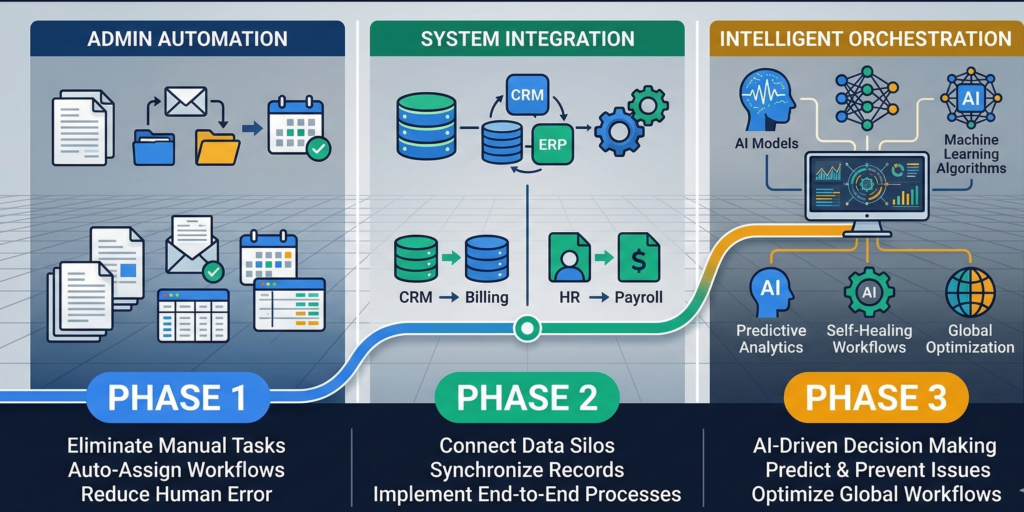
Phase 1 — High-frequency admin workflows
Start with:
- intake automation
- scheduling
- CRM updates
These produce fast operational wins.
Phase 2 — Cross-system coordination
Automate processes that move information between systems:
- lead routing
- internal notifications
- reporting updates
Phase 3 — Intelligent workflow orchestration
Introduce more advanced automation:
- voice AI customer interactions
- dynamic workflow routing
- predictive task handling
Each phase expands automation gradually while maintaining operational stability.
[INTERNAL LINK: AI Automation ROI Framework]
Operational takeaway:
Automation works best when implemented incrementally rather than all at once.
Conclusion
Operational bottlenecks rarely stem from poor strategy or weak teams.
They emerge from friction inside everyday workflows—the repetitive coordination tasks that quietly consume operational capacity.
Scheduling, intake, data entry, routing, and follow-ups may appear mundane. Yet they shape response speed, customer experience, and the ability to scale operations efficiently.
AI workflow automation addresses these problems at their structural level. Instead of accelerating manual processes, it removes the need for many of them entirely.
For operations leaders, the opportunity is not simply cost reduction. It is the ability to build systems where routine coordination happens automatically while teams focus on work that requires human judgment.
Organizations that treat automation as a strategic capability—not just a tool—gain a decisive advantage in operational speed and adaptability.
For teams evaluating their next steps, the most valuable starting point is often simple: map your workflows and measure where time is truly being spent.
[INTERNAL LINK: AI Adoption Strategy for Enterprises]
[INTERNAL LINK: Enterprise AI Governance Checklist]
FAQ Section
What is AI workflow automation?
AI workflow automation uses artificial intelligence to execute operational processes automatically. It coordinates tasks such as scheduling, intake, CRM updates, and communication across systems without manual intervention. Instead of employees moving information between tools, AI systems orchestrate workflows based on predefined rules and business logic.
How does AI workflow automation improve operational efficiency?
AI workflow automation reduces operational friction by removing repetitive coordination tasks. Scheduling, data entry, routing, and follow-ups occur automatically across systems. This shortens response times, prevents manual errors, and allows employees to focus on complex work rather than administrative processes.
What business processes are easiest to automate with AI?
Processes that are repetitive, rule-based, and high-frequency are typically the easiest to automate. Examples include lead intake, appointment scheduling, CRM updates, follow-up communication, and internal request routing. These workflows often follow predictable steps that AI systems can execute reliably.
Is AI workflow automation difficult to implement?
Implementation complexity depends largely on system integration. Automation platforms must connect with existing tools such as CRM systems, communication platforms, and scheduling software. Organizations that begin with simple workflows and expand gradually typically achieve smoother adoption.
How do operations teams identify automation opportunities?
Operations leaders should evaluate workflows based on frequency, time cost, revenue impact, rule clarity, and system integration feasibility. Processes that score highly across these categories are strong candidates for automation because they deliver meaningful efficiency improvements.
Does AI workflow automation replace operations staff?
Automation usually changes the type of work employees perform rather than eliminating roles. Administrative coordination tasks are automated, allowing staff to focus on higher-value activities such as problem solving, customer interaction, and strategic operational planning.