

A potential customer calls your business at 7:42 PM.
The office closed 40 minutes earlier.
No one answers.
That customer hangs up and calls the next provider.
No complaint. No email. No second chance.
Just lost revenue.
Most small and mid-sized businesses underestimate how often this happens. Phone inquiries remain one of the highest-intent signals in sales, yet the majority of businesses still rely on human receptionists available only during office hours.
The math is simple: every unanswered call represents a possible lost deal.
This is where AI phone answering for business changes the equation. Modern voice AI systems can answer calls instantly, qualify leads, schedule appointments, and capture contact details—even when the office is closed.
Instead of missing opportunities, businesses capture them automatically.
When implemented correctly, AI call handling acts as a 24/7 front desk that never misses a lead.
This article explains how AI phone answering systems capture revenue after hours, how the technology qualifies potential customers during calls, and how businesses measure the real ROI of automated call handling.
The Hidden Revenue Cost of Missed Business Calls
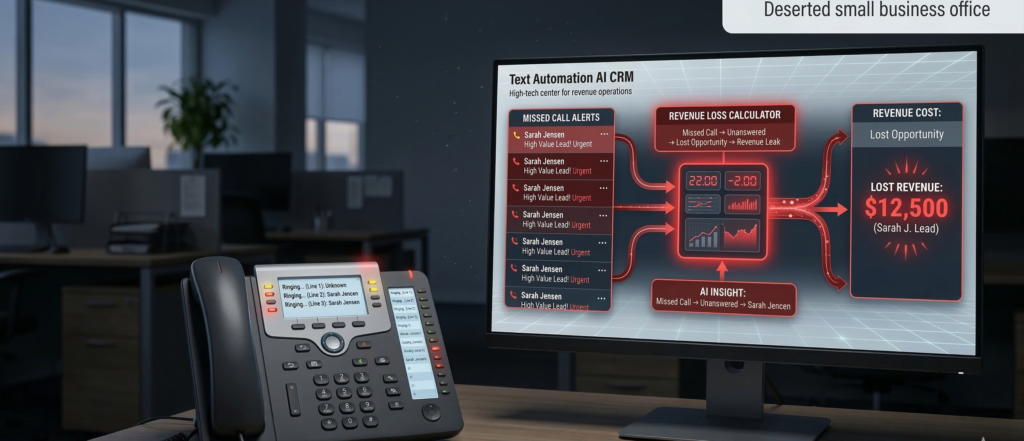
Most businesses assume missed calls are rare.
In practice, they’re surprisingly common.
Calls are missed when:
- Staff are already assisting customers
- Calls arrive after closing hours
- Lunch breaks or shift changes occur
- Reception desks are temporarily unattended
- Call volumes spike unexpectedly
Each missed call may represent a customer ready to buy.
Why Phone Calls Represent High-Intent Leads
Compared to web forms or email inquiries, phone calls usually indicate stronger purchase intent.
When someone calls a business, they often want:
- Immediate answers
- Pricing information
- Appointment availability
- Service confirmation
- Urgent assistance
In many industries—legal services, healthcare clinics, real estate offices, home services—a phone call often occurs at the decision stage of the buying process.
If that call goes unanswered, the customer rarely waits.
They call a competitor.
A Simple Revenue Reality
Consider a typical service business:
- 40 inbound calls per week
- 20% occur outside office hours
- 8 calls missed weekly
If even two of those callers were ready to purchase, the business just lost multiple sales opportunities.
Over months, that becomes a meaningful revenue gap.
The issue isn’t demand.
It’s availability.
Key takeaway:
Missed calls rarely feel dramatic, but they quietly drain revenue over time.
How AI Phone Answering for Business Works
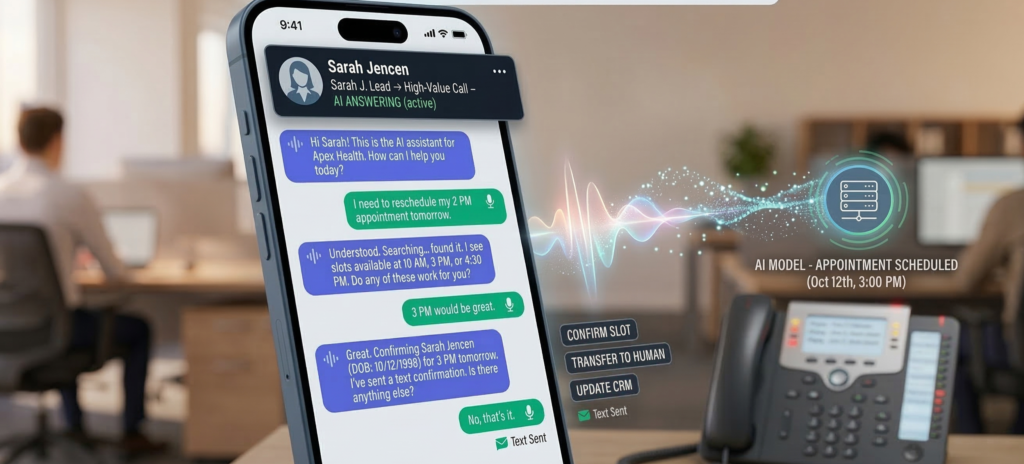
Modern AI call answering systems behave much differently than traditional phone menus.
Instead of rigid “press 1 for sales” systems, voice AI understands natural speech and carries on structured conversations.
Core Components of AI Call Handling
A typical AI phone answering system includes three layers.
1. Voice Interface
Callers speak normally.
The AI system converts speech into text, interprets intent, and generates responses.
2. Conversation Engine
The AI follows configurable conversation flows such as:
- answering questions
- qualifying inquiries
- collecting contact details
- routing urgent requests
3. Business System Integration
Information captured during the call is automatically sent to internal systems such as:
- CRM platforms
- scheduling software
- support ticketing tools
This means every interaction becomes usable business data.
What Callers Experience
From the caller’s perspective, the experience is simple.
They dial the business number and hear a natural greeting such as:
“Thanks for calling. How can I help you today?”
From there, the AI can:
- answer common questions
- schedule appointments
- collect contact information
- route urgent issues
Unlike voicemail, the caller receives immediate assistance.
Where Businesses Deploy AI Call Handling
AI answering systems are commonly used in industries where phone calls drive revenue:
- medical practices
- law firms
- home service companies
- real estate offices
- consulting businesses
Key takeaway:
AI call answering systems function as an always-available digital receptionist that captures opportunities instead of letting them disappear.
24/7 After-Hours Lead Capture
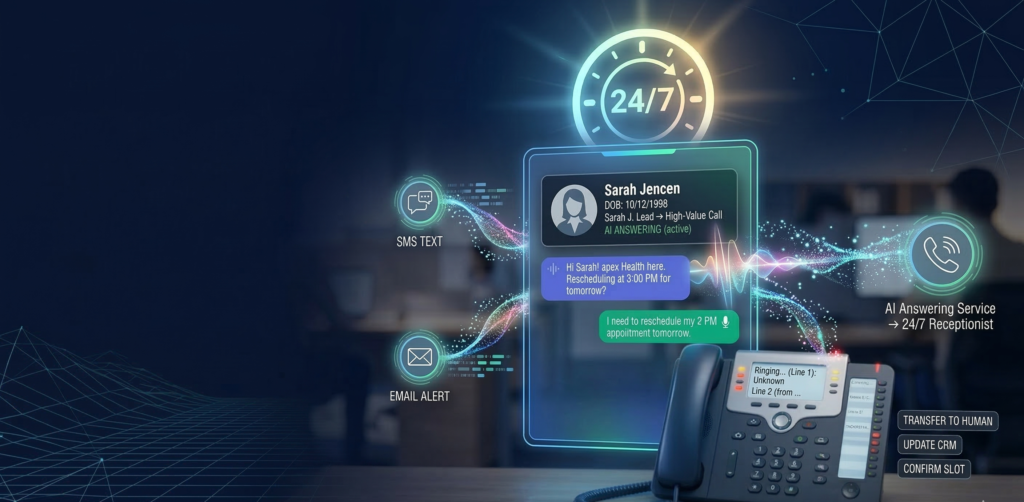
After-hours calls represent a major blind spot for most businesses.
Even companies with dedicated reception staff typically stop answering calls after closing time.
That’s precisely when many potential customers begin researching services.
Why After-Hours Calls Matter
Customers often call outside business hours because:
- they are researching services in the evening
- they need urgent help
- they are comparing providers after work
- they remembered a task late at night
If the call isn’t answered, the lead disappears.
Voice AI removes that limitation entirely.
How AI Handles After-Hours Conversations
AI answering systems can be configured to handle evening calls differently from daytime calls.
For example:
During office hours:
- transfer complex requests to staff
- schedule appointments directly
After hours:
- capture lead details
- answer common questions
- schedule next-day appointments
- send confirmation messages
This ensures the caller receives assistance even when human staff are unavailable.
Why AI Outperforms Voicemail
Voicemail rarely converts leads effectively.
Callers often avoid leaving messages because:
- it feels slow
- they expect delayed responses
- they worry the message may be missed
A conversational AI experience changes that dynamic.
Instead of leaving a message, the caller completes the interaction immediately.
Key takeaway:
After-hours lead capture often produces some of the easiest revenue gains because it closes a gap that previously existed every night.
Lead Qualification During AI Phone Conversations
Capturing calls is valuable.
Qualifying them is even more valuable.
Businesses don’t just want inquiries—they want qualified opportunities.
Voice AI systems can gather structured information during calls to determine whether a lead is worth pursuing.
What AI Can Qualify During a Call
Depending on the business type, AI can collect details such as:
- service type requested
- location or service area
- timeline for the project
- estimated budget
- urgency level
For example:
A landscaping company might configure the AI to ask:
- What type of landscaping service do you need?
- Is this for residential or commercial property?
- When would you like the work completed?
These responses help staff prioritize the most promising leads.
Structured Lead Data Improves Follow-Up
When staff review captured leads the next day, they don’t just see a phone number.
They see structured information such as:
- caller name
- service requested
- urgency level
- appointment preferences
This improves response speed and relevance.
The Operational Advantage
Without AI, this information would only exist if someone answered the call.
With AI, every caller becomes structured data inside the business workflow.
Key takeaway:
AI call qualification ensures captured leads are immediately actionable.
CRM Auto-Entry and Workflow Automation
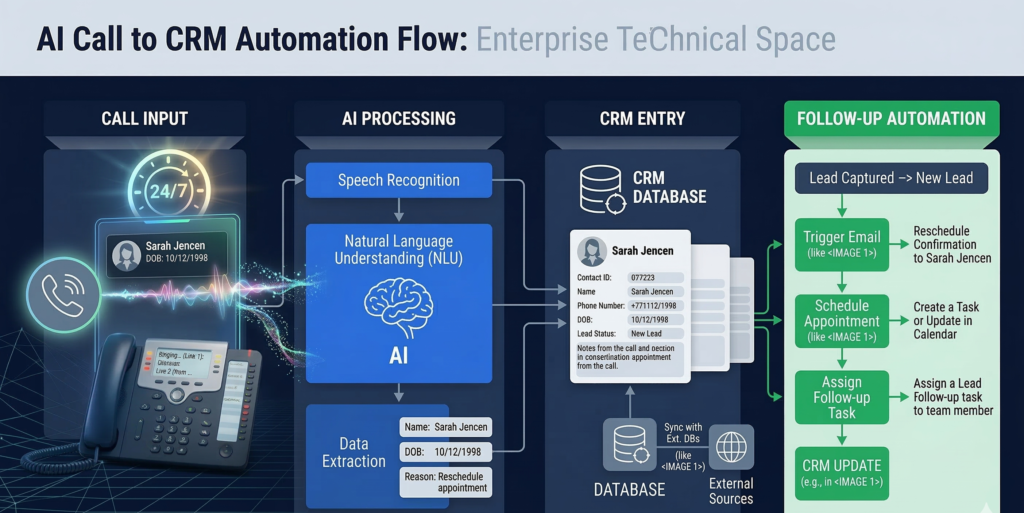
Capturing lead information manually creates friction.
Staff must listen to voicemail, transcribe notes, and enter data into CRM systems.
AI eliminates that step entirely.
Automatic Lead Logging
When AI answers a call, the captured data can be automatically logged in systems such as:
- CRM platforms
- customer databases
- appointment schedulers
- support ticket systems
This means the lead already exists in the system before staff review it.
Workflow Automation After the Call
Once the call ends, automation workflows can trigger actions such as:
- sending confirmation emails
- assigning leads to sales staff
- scheduling follow-up calls
- updating sales pipelines
The entire process occurs without manual intervention.
Operational Example
Consider a real estate brokerage.
After-hours AI calls might automatically:
- Capture the buyer’s contact information
- Record property interest
- Schedule a call with an agent
- Create a CRM opportunity
By the time the agent logs in the next morning, the lead is already prepared for follow-up.
Platforms like Aivorys (https://aivorys.com) are designed for this exact workflow—combining voice AI call handling with CRM-connected automation and structured lead capture.
Key takeaway:
AI call answering becomes significantly more valuable when integrated directly into the company’s operational systems.
The Conversion Impact of Instant Call Response
Speed matters in sales.
Research and practitioner experience consistently show that faster responses dramatically increase lead conversion.
The reason is simple.
When someone calls a business, they are actively evaluating providers.
If the first provider responds instantly, the search may end there.
Why Response Time Drives Conversion
Several psychological factors are involved.
Momentum
The caller is already engaged and ready to act.
Trust
Immediate responses signal professionalism and reliability.
Convenience
Customers prefer the fastest solution.
When a business answers immediately—whether with staff or AI—it captures that moment of intent.
AI Ensures Every Call Gets a Response
Human staff cannot guarantee 100% availability.
AI systems can.
Every call receives:
- immediate greeting
- structured assistance
- captured information
Even if the caller doesn’t book immediately, the business still retains contact information for follow-up.
Key takeaway:
Speed of response is one of the most overlooked drivers of conversion—and AI ensures response speed never drops to zero.
A Simple ROI Framework for AI Call Automation
Businesses evaluating AI phone answering often ask a straightforward question:
Will this actually pay for itself?
The answer usually depends on missed call volume.
The Missed Call Revenue Formula
A simple calculation illustrates potential ROI.
Step 1: Estimate missed calls
Example:
30 missed calls per month
Step 2: Estimate conversion rate
If even 10–20% convert, that means:
3–6 new customers monthly
Step 3: Estimate average customer value
If the average sale equals $500:
Monthly captured revenue:
$1,500–$3,000
Even conservative assumptions can produce meaningful returns.
ROI Checklist for AI Phone Answering
Businesses evaluating AI systems should ask:
- How many calls do we currently miss each week?
- What percentage of calls represent potential sales?
- What is the average revenue per new customer?
- How quickly do staff follow up on voicemail leads?
- What percentage of missed callers never call again?
These answers reveal the true cost of missed opportunities.
Key takeaway:
AI call answering often produces ROI not by increasing traffic—but by capturing demand that already exists.
Conclusion
Most businesses focus on generating more leads.
Fewer examine how many leads they already lose.
Missed calls are one of the most persistent—and invisible—sources of lost revenue. Each unanswered call represents a moment when a customer reached out and received no response.
AI phone answering for business closes that gap.
Instead of relying solely on human availability, businesses can deploy voice AI systems that answer calls instantly, qualify opportunities, log leads automatically, and trigger follow-up workflows.
The operational impact is simple but powerful: every caller receives a response, and every conversation becomes usable data.
For organizations where phone calls drive sales, this change alone can reshape how revenue is captured.
Exploring how AI call automation fits into existing phone systems and CRM workflows is often the first practical step toward eliminating missed opportunities entirely.
FAQ — AI Phone Answering for Business
What is AI phone answering for business?
AI phone answering for business uses voice AI technology to answer incoming calls automatically. Instead of sending callers to voicemail, the system holds a conversation, collects information, answers questions, and can schedule appointments or route inquiries. The goal is to ensure every call receives a response—even outside business hours.
Can AI answer calls after business hours?
Yes. One of the main advantages of AI call answering is 24/7 availability. Businesses can configure AI systems to capture leads, collect contact information, and schedule follow-up appointments during evenings, weekends, and holidays when staff are unavailable.
How does AI qualify leads during phone calls?
AI systems can ask structured questions during the call. For example, they might ask about service type, location, urgency, or budget. The answers are stored and sent to the company’s CRM system so staff can prioritize high-value leads when they follow up.
Will callers know they are speaking to AI?
Some callers recognize the interaction as automated, while others simply experience it as a conversational assistant. The key factor is design. When configured properly, AI conversations feel natural and focused on helping the caller complete their request quickly.
Can AI phone answering integrate with CRM systems?
Most modern AI call platforms integrate with CRM and scheduling systems. When a call ends, the system can automatically create a lead record, update customer data, or trigger workflows such as follow-up emails or appointment confirmations.
Is AI phone answering expensive for small businesses?
Costs vary depending on call volume and system capabilities, but many businesses find that the revenue recovered from previously missed calls quickly offsets the expense. The most accurate evaluation compares system cost with the value of captured leads that would otherwise be lost.