

Most AI discussions start in the wrong place.
Teams evaluate tools, compare vendors, debate model capabilities, or analyze software pricing. Meanwhile the CFO is asking a very different question:
What is the actual financial return of automation across the business?
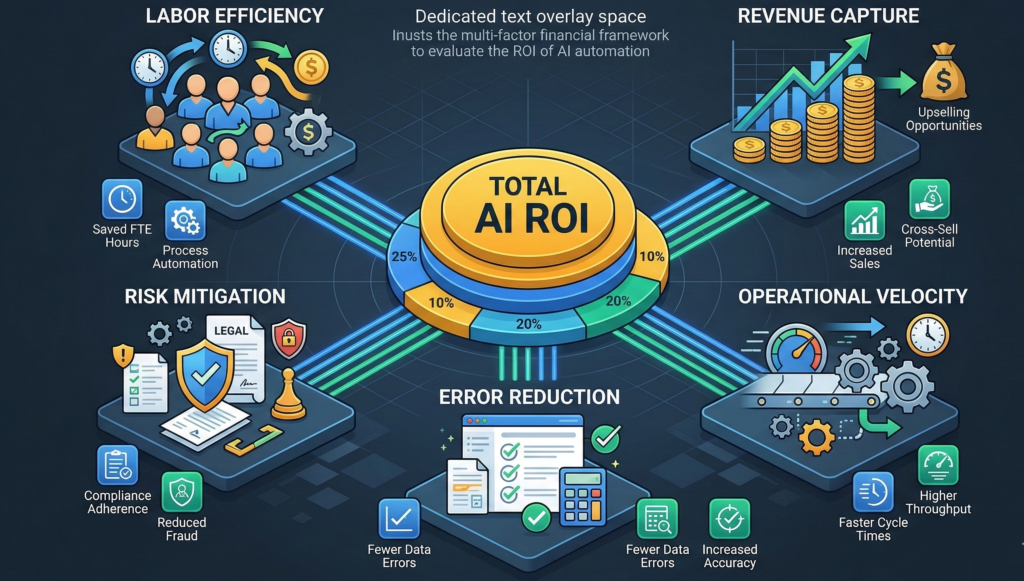
Calculating AI automation ROI is rarely as simple as subtracting software cost from labor savings. In practice, automation affects multiple financial levers simultaneously:
- operational staffing requirements
- missed revenue opportunities
- error reduction and compliance exposure
- speed of response to customers and leads
- throughput of operational workflows
When organizations underestimate these dynamics, they undervalue AI investments or delay adoption entirely.
Finance leaders who approach automation strategically use a broader evaluation model. Instead of measuring AI as a software purchase, they treat it as an operational multiplier that affects revenue capture, cost structure, and execution speed.
This article breaks down the financial framework CFOs use to evaluate automation initiatives, including how to quantify productivity gains, risk mitigation, and operational velocity. By the end, you’ll see why organizations increasingly treat AI infrastructure as a core driver of enterprise efficiency rather than a discretionary technology experiment.
Hard ROI vs Soft ROI: The Two Financial Layers of Automation
Most ROI discussions collapse automation value into a single number.
That approach hides half the impact.
Finance teams evaluating AI automation ROI typically separate outcomes into two categories: hard financial return and soft operational return.
Hard ROI: Direct Financial Impact
Hard ROI represents measurable financial outcomes that directly affect the income statement.
Examples include:
- Labor cost reduction from automating repetitive tasks
- Lower support staffing needs due to automated call handling
- Reduced operational overhead in scheduling, intake, or documentation
- Increased lead conversion revenue due to faster response times
These metrics translate cleanly into financial models.
For example, replacing three call-handling roles with automation could represent:
- $180,000 annual labor savings
- reduced hiring and training costs
- lower operational variability
These are the numbers CFOs typically expect to see first.
Soft ROI: Operational Efficiency Gains
Soft ROI measures improvements that influence business performance indirectly.
These include:
- faster response times to customers
- higher operational throughput
- better data accuracy
- improved customer experience
These benefits often translate into revenue impact over time rather than immediate cost reduction.
Common misconception: Many organizations undervalue automation because they only calculate hard ROI.
Why Both Matter
Hard ROI answers the CFO’s immediate financial question.
Soft ROI explains why organizations that automate early often outperform competitors.
Financial takeaway: A complete AI automation ROI model must quantify both direct cost savings and operational acceleration.
The Hidden Cost of Missed Calls and Delayed Responses
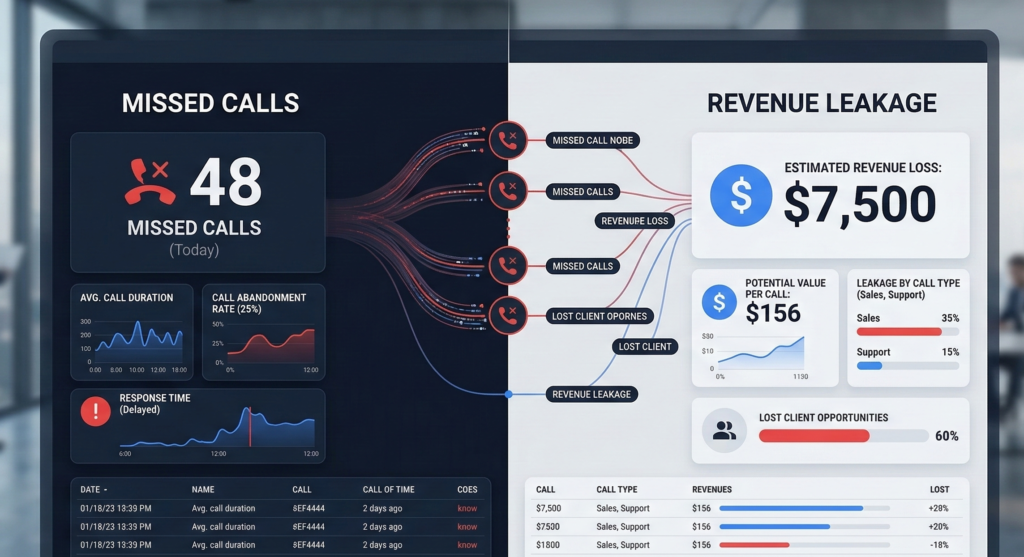
One of the most underestimated ROI drivers in automation is lost opportunity.
Customer inquiries frequently arrive outside business hours or during peak call volume. When businesses fail to respond quickly, those opportunities vanish.
The Economics of Missed Communication
Consider a typical service-based organization receiving:
- 150 inbound calls per week
- 20% unanswered during peak periods
That equates to 30 missed opportunities weekly.
Even a modest conversion rate can reveal surprising revenue loss.
Example:
- average deal value: $1,500
- conversion rate: 10%
Missed calls could represent:
$4,500 in lost revenue weekly
or $234,000 annually
This scenario appears across multiple industries:
- medical practices missing appointment requests
- law firms missing intake calls
- real estate teams missing buyer inquiries
- logistics providers missing service requests
Why Speed Matters
Research across customer experience domains consistently shows that response speed directly affects conversion probability.
A delayed response can push prospects toward competitors who answer first.
Voice AI systems mitigate this risk by ensuring inbound calls are always answered and triaged, even outside standard business hours.
Financial takeaway: Revenue capture from improved response coverage is often one of the largest contributors to AI automation ROI.
Modeling Productivity Gains from AI Automation

Labor efficiency remains one of the clearest financial benefits of automation.
However, many organizations miscalculate productivity gains by assuming a one-to-one replacement model.
Automation rarely eliminates entire roles. Instead, it removes high-volume repetitive tasks, allowing employees to focus on higher-value work.
The Automation Productivity Multiplier
A practical modeling approach evaluates how automation shifts time allocation.
Example scenario for a service operations team:
| Task | Time Spent | Automation Impact |
|---|---|---|
| Phone intake | 30% | Automated |
| Appointment scheduling | 20% | Automated |
| Data entry | 15% | Reduced |
| Customer follow-up | 15% | Assisted |
| Complex case handling | 20% | Human |
With automation handling routine tasks, the same team can support significantly more customers without increasing headcount.
Throughput Expansion
Rather than reducing staff, many organizations experience:
- higher daily customer capacity
- shorter response times
- improved service consistency
This leads to operational scalability without proportional hiring.
Workforce Reallocation
Another advantage appears when staff are reassigned from administrative tasks to revenue-generating work.
Examples include:
- sales follow-ups
- relationship management
- high-value consulting activities
Financial takeaway: Productivity modeling should measure increased operational throughput, not just reduced headcount.
Risk Mitigation and Error Reduction as ROI Drivers
Automation also produces financial value by reducing operational mistakes.
Errors may appear small in isolation but accumulate significant cost across large organizations.
Common Operational Errors
Manual workflows frequently introduce issues such as:
- incorrect data entry
- missed follow-ups
- inconsistent documentation
- scheduling conflicts
Each of these errors carries hidden costs.
Examples include:
- rework time for staff
- customer dissatisfaction
- compliance exposure
- revenue delays
Automation as a Governance Layer
AI systems can enforce consistent workflows.
Instead of relying on human memory or manual processes, automation can:
- validate required data fields
- trigger follow-up tasks automatically
- escalate unresolved issues
- log interactions for audit purposes
This is particularly valuable in regulated industries where documentation and traceability matter.
Platforms like Aivorys (https://aivorys.com) are designed with this operational governance model in mind, connecting voice automation, workflow triggers, and CRM systems so customer interactions consistently follow defined processes.
Financial takeaway: Error reduction and compliance safeguards reduce operational risk costs that traditional ROI models often ignore.
Calculating the True Lifecycle Cost of AI Deployment
ROI cannot be evaluated without understanding the full cost structure of automation initiatives.
Focusing only on subscription fees produces misleading analysis.
Finance teams typically model total lifecycle cost across several categories.
1. Implementation Costs
Initial deployment often includes:
- system configuration
- workflow design
- integration with existing systems
- staff training
These costs are usually one-time investments.
2. Infrastructure and Platform Fees
Recurring costs may include:
- AI platform licensing
- telephony infrastructure
- data storage
- analytics services
These costs scale with usage.
3. Maintenance and Optimization
Automation systems require ongoing refinement.
Examples include:
- conversation flow improvements
- prompt tuning
- integration updates
Organizations should account for these operational costs in long-term projections.
4. Governance and Security
Enterprises may also invest in:
- compliance reviews
- security audits
- monitoring tools
Financial takeaway: CFOs evaluate AI automation ROI across a multi-year lifecycle rather than a single-year cost comparison.
The CFO’s AI Automation ROI Framework
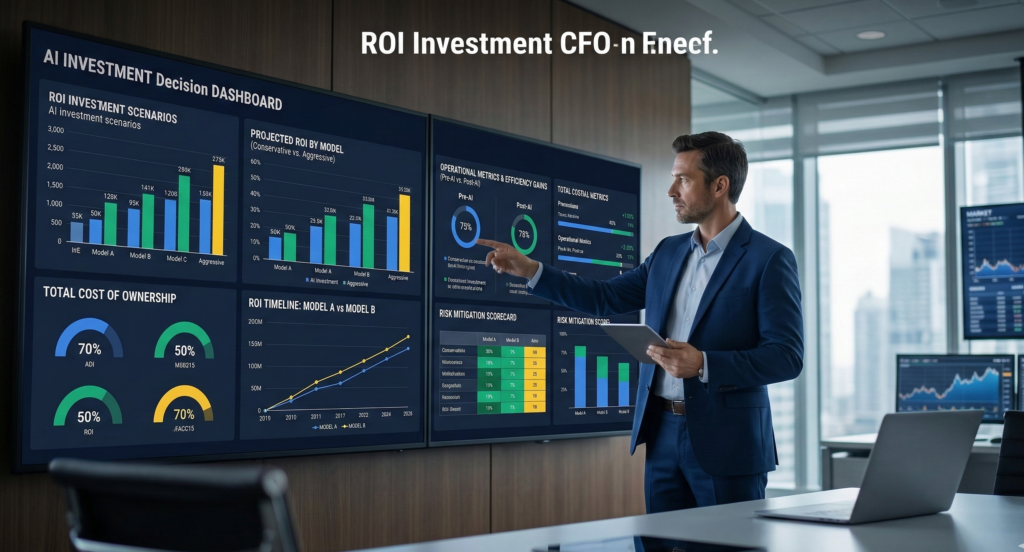
To standardize evaluation, finance leaders often apply a structured model.
The Enterprise AI ROI Scoring Framework
Evaluate each category on estimated annual impact.
| ROI Category | Key Question |
|---|---|
| Labor Efficiency | How much staff time can automation reclaim? |
| Revenue Capture | How many opportunities are currently missed due to response delays? |
| Throughput Growth | How many more customers can the team serve with automation? |
| Error Reduction | What operational mistakes can be prevented? |
| Risk Mitigation | Does automation improve documentation and compliance controls? |
| Operational Velocity | How much faster can workflows execute? |
Interpreting the Results
Organizations typically see ROI emerge through three mechanisms:
- Cost reduction through administrative automation
- Revenue expansion from improved responsiveness
- Operational scalability without hiring
[INTERNAL LINK: Enterprise AI Deployment Strategy]
Strategic takeaway: AI automation ROI emerges from cumulative operational improvements rather than a single cost-saving metric.
A Sample AI ROI Model Walkthrough
To illustrate the framework, consider a mid-sized service business evaluating automation for customer intake and scheduling.
Current Operating Model
- 4 intake staff handling calls
- 1,000 inquiries per month
- average deal value: $2,000
- 18% missed calls during peak periods
Estimated Automation Impact
Revenue capture
Reducing missed calls from 18% to 3% could recover:
- ~150 additional conversations monthly
- ~15 new deals at 10% conversion
Monthly revenue impact: $30,000
Labor Efficiency
Automation handling intake and scheduling may reduce administrative workload by 40%.
Instead of hiring two additional staff as volume grows, the organization operates with the existing team.
Annual savings: $120,000+
Operational Velocity
Faster response times shorten sales cycles and increase customer satisfaction.
This often produces secondary revenue gains that compound over time.
[INTERNAL LINK: Voice AI Implementation Guide]
Financial takeaway: AI automation ROI often compounds across revenue capture, productivity gains, and operational scalability.
FAQ — AI Automation ROI
What is AI automation ROI?
AI automation ROI measures the financial return generated by deploying AI systems to automate business operations. It typically includes labor savings, improved revenue capture, productivity gains, reduced operational errors, and faster workflow execution. Finance teams evaluate these benefits against the total cost of implementation and ongoing infrastructure.
How do CFOs evaluate AI investments?
CFOs evaluate AI investments using multi-factor financial models rather than simple cost comparisons. These models analyze operational cost savings, revenue expansion opportunities, productivity gains, risk reduction, and long-term scalability. The goal is to determine how automation affects both profitability and operational efficiency.
How long does it take for AI automation to deliver ROI?
Many organizations see measurable ROI within the first year of deployment. Operational automation often produces immediate efficiency improvements, while revenue gains from faster response times and improved customer experiences accumulate gradually over time.
What industries see the highest ROI from AI automation?
Service-intensive industries often experience strong returns. These include healthcare, legal services, real estate, financial services, logistics operations, and SaaS companies with large customer interaction volumes. High call volume and repetitive operational workflows create ideal conditions for automation.
What are the biggest mistakes companies make when calculating AI ROI?
The most common mistake is focusing only on software cost or headcount reduction. Organizations often overlook revenue capture from improved response times, productivity gains from automated workflows, and operational risk reduction through standardized processes.
Can AI automation increase revenue instead of just reducing costs?
Yes. Many automation deployments generate revenue growth by improving responsiveness to customers, increasing sales team capacity, and ensuring opportunities are not missed due to delayed follow-up. In these cases, automation acts as a revenue accelerator rather than simply a cost-cutting tool.
Conclusion
Finance leaders rarely approve technology investments based on novelty.
They approve initiatives that strengthen operational performance and measurable financial outcomes.
AI automation sits at the intersection of both.
When evaluated through a narrow lens of software cost, automation can appear incremental. Viewed through the broader framework used by experienced CFOs, the impact becomes clearer. Labor efficiency improves. Revenue opportunities increase. Operational risk declines. Teams scale without proportional hiring.
These dynamics explain why automation is increasingly treated as infrastructure rather than experimentation.
Organizations exploring AI adoption often benefit from modeling potential outcomes before deployment. A structured ROI projection can clarify where automation produces the strongest financial leverage and which operational processes should be prioritized first.