
Can a simple request make checkout feel natural, fast, and even personal? We ask this because 8.4 billion digital assistants are active worldwide in 2024, and that scale is reshaping commerce today.
We introduce what this means for online retail across the United States. Voice commerce is moving from a novelty to a core capability that shortens paths and reduces steps for customers.
Our aim is to show what changes now, what matters most, and where teams find practical wins first. We cover how buying differs from search, which support moments add value after checkout, and how to measure impact with conversion and service metrics.
We also clarify one key point: screens stay central. Assistants complement e-commerce across mobile, smart speakers, and phone tools, depending on context and customer preference.
Key Takeaways
- Today’s assistants are mainstream and reshape shopping behavior.
- Voice commerce reduces friction and speeds decision paths.
- Top use cases include support and post-purchase loyalty.
- Measure impact with conversion, CX, and efficiency metrics.
- Screens and conversational tools work together, not as substitutes.
Why voice commerce is accelerating in the United States right now
We see device growth turning casual use into routine shopping behavior. As more conversational devices appear, expectations for fast, hands-free purchase paths rise.
From 4.2 billion to 8.4 billion assistants: what scale means for commerce
Scale changes everything. Assistants doubled from 4.2 billion (2020) to 8.4 billion (2024). That jump raises baseline familiarity and raises the bar for digital stores to offer faster, natural interactions.
| Metric | 2020 | 2024 | Practical impact |
|---|---|---|---|
| Active assistant devices | 4.2B | 8.4B | Broader reach; more touchpoints |
| U.S. shoppers using voice search | — | 49% (~128.4M) | Optimize product copy and flows |
| Results speed | Baseline | 52% faster (avg 4.6s) | Lower friction; fewer drop-offs |
| Speaking vs typing speed | 40 wpm (typing) | 150 wpm (speaking) | Quicker queries; richer intent |
How many Americans use voice search and what that signals
About 49% of U.S. consumers use voice search for shopping—roughly 128.4 million people.
This shows that conversational shopping is mainstream. We should treat optimization for these behaviors as standard readiness for online stores.
Why shoppers prefer speaking over typing
Seventy-one percent of consumers say they prefer speaking to typing. Spoken requests are longer and more natural, which affects how product queries are phrased.
Speaking is faster: people voice ~150 words per minute versus ~40 when typing. Combined with results that load 52% faster, this reduces friction and speeds time-to-answer.
Smartphones lead adoption, but home devices keep shaping repeat orders and replenishment habits.
What “voice commerce” really means compared to voice search
Understanding the gap between asking for information and completing an order changes how we design shopping flows.
Voice search finds results; voice commerce completes orders end-to-end
Voice search answers queries: it finds product details, specs, or store hours. It stops at results and hands back information.
Voice commerce goes further. It supports discovery, adds items to a cart, completes payment, and confirms delivery or tracking. That end-to-end path requires tight links to catalog, inventory, payment, and CRM systems.
“A true commerce flow must do more than reply — it must act on the customer’s intent and close the loop.”

Where voice fits in the modern shopping journey: discovery, compare, purchase, support
Map the customer path to prioritize work. Discovery involves broad queries like “best running shoes under $100.” Compare covers side-by-side details and reviews. Purchase handles cart, payment, and confirmation. Support answers follow-ups, such as “where’s my order?”
Intent shifts by stage. Discovery seeks options; repeat orders ask to reorder; support needs status and remedies. To avoid dead ends, commerce systems must sync with real-time data and order records.
- Discovery: intent-rich queries that surface product choices.
- Compare: deeper specs, ratings, and shortlists.
- Purchase: cart actions, payment confirmation, and receipts.
- Support: tracking, returns, and customer service updates.
How voice AI works under the hood for ecommerce experiences
Behind every hands-free purchase is a chain of systems that translate sound into commerce actions. We split that pipeline into three clear layers that must work together.
Speech recognition that turns audio into text
Automatic speech recognition (ASR) converts audio to text. High accuracy matters for sizes, SKUs, and addresses. Poor text causes wrong items and failed orders.
Natural language understanding for intent and context
NLU extracts intent, entities, and user needs. It detects budget limits, preferred brands, or reorder timing so responses feel helpful rather than robotic.
Machine learning that refines responses over time
ML adapts to accents and language patterns common across the United States. Models learn from real queries and improve accuracy for future interactions.
Integration is the make-or-break factor. Catalog quality, tokenized payment paths, and carrier tracking links must be reliable. Missing data or messy systems breaks the flow.
“If product, payment, or delivery systems aren’t synced, smart recognition alone won’t complete the order.”
| Layer | Primary role | Key risk |
|---|---|---|
| ASR | Audio → text | Mis-transcribed SKUs |
| NLU | Intent & context | Wrong intent detection |
| ML | Continuous improvement | Bias across accents |
| Integrations | Catalog, payment, tracking | Broken or stale data |
voice AI in ecommerce use cases we can implement today
Today’s priorities are clear: launch reliable helpers that save customers time and reduce friction. We focus on practical features that deliver measurable results fast.
Personalized shopping assistants that recommend products and drive convenience
Personal assistants use order history and preferences to surface relevant product options and deals. Recommendations can suggest alternatives, bundle offers, or best-fit sizes without forcing manual filters.
Voice-first product discovery with specs, review summaries, and comparisons
Guided conversations present specs and short review summaries so customers compare options quickly. When shoppers ask “what’s best under $100,” the system returns ranked product choices and clear trade-offs.
Shopping lists, reordering, and subscriptions that reduce time and repeat friction
Lists and one-tap reorders turn replenishment categories into habits. Subscriptions remove repeat friction and shorten the path from need to purchase.
Voice-enabled customer service for order status, tracking, and returns
Self-serve flows answer order status and tracking questions instantly, with warm transfers when agents are needed. Quick returns guidance reduces churn and improves post-purchase service.
Voice authentication and secure checkout with multi-factor protections
Secure convenience pairs biometric checks with tokenized payment options like PayPal or Google Pay. That keeps payment steps short while protecting customer trust.
- High ROI: personalized recommendations, repeat orders, and instant tracking.
- Integration wins: sync catalog, payment, and carrier data for reliable responses.
Bottom line: implement these core use cases to reduce time-to-purchase, cut friction, and improve conversion across commerce touchpoints.
Voice-enabled customer service that scales support without sacrificing experience
We start where the need is clearest: customer questions about orders are frequent, predictable, and ripe for automation. By handling common intents first, we create measurable savings while keeping service quality high.
Automating “Where’s my order?” with real-time tracking
WISMO is often the top call driver. When we link tracking feeds and 3PL events, customers hear accurate status and delivery windows instead of generic scripts.
Self-serve flows for modifications and subscription changes
We build rules for cancellations, modification windows, and when to tag an order versus cancel via API. Self-serve paths reduce hold time and speed up responses.
Save motions that cut returns and prevent cancellations
Save offers — exchanges, replacement items, delayed shipments, or targeted discounts — reduce churn. These options often recover revenue and protect loyalty.
After-hours handling that improves speed metrics
After-hours support lowers missed calls and improves average handle time. Clear expectations and handoffs keep customers informed and boost trust.
“Automate repetitive intents first; the operational wins fund broader commerce features.”
| Use case | Primary gain | Key enabler |
|---|---|---|
| WISMO automation | Faster status answers | Real-time tracking & 3PL events |
| Order modifications | Lower AHT | Rule-based APIs |
| Save offers | Fewer returns, higher revenue | Targeted incentives |
| After-hours support | Reduced missed calls | Phased automation + handoffs |
How voice AI improves customer experience and loyalty across the store
Small, hands-free moments—while cooking, cleaning, or working—let customers finish quick purchases without opening an app. These micro-moments create new habits that boost repeat behavior across the store.
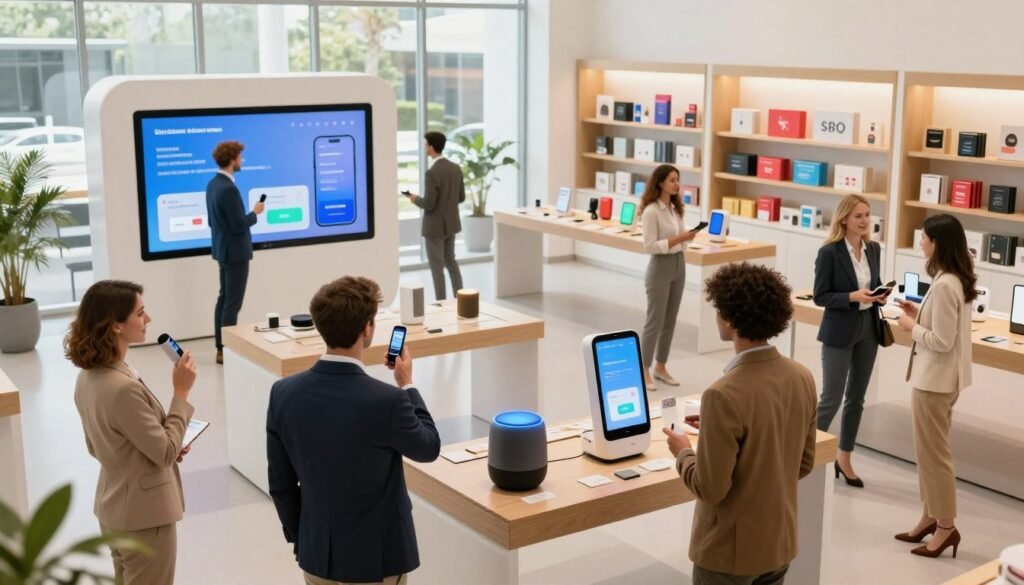
Hands-free shopping moments that create new habits and repeat orders
When customers reorder while doing another task, the path to repurchase shortens. A successful, low-effort interaction makes the next buy feel natural.
We see reorders and subscriptions rise when assistants nudge customers with reminders and one-step confirmations. That nudge builds loyalty and increases lifetime value.
Speed matters: why voice results can feel faster and more responsive than traditional search
Perceived speed drives satisfaction. Results that load 52% faster (about 4.6 seconds) and speaking at ~150 wpm versus typing at ~40 wpm both shorten the time to answer.
Faster queries let customers say what they want naturally— for example, “show me red ones under fifty dollars,” which trims filter steps and keeps the exchange conversational.
“When convenience and quick, accurate results come together, customers choose the path that saves them time.”
Bottom line: treat voice commerce as a store‑wide layer that supports discovery, purchase, and post‑purchase care. Done well, it improves customer experience and drives loyalty without replacing screens.
Revenue impact: where voice can lift sales, conversion, and retention
Revenue gains come when support shifts from cost center to a direct sales channel.
Support-to-sales plays let us route qualified buyers, trigger offers, and reduce churn. Detecting purchase intent during a call or chat can escalate a lead to a sales queue. We can also suggest a relevant product accessory at the right moment to increase conversion.
Turning support interactions into a performance channel for marketing activations and direct sales
By adding simple triggers, support becomes a measurable marketing channel. We can push limited-time deals, enroll customers in trials, or capture opt-ins for follow-up campaigns.
What personalization can do for average order value and repeat purchase behavior
Using order history, preferences, and context lets us craft recommendations that lift AOV. Sephora reported a 35% AOV increase via a conversational assistant versus their website, showing the power of tailored suggestions.
Faster issue resolution, better save offers, and seamless reorders improve retention. Measurable outcomes should tie back to attributed sales, conversion rate, and lifetime value—not just brand metrics.
Platforms and devices powering voice shopping and voice assistants
Devices shape how people shop: phones handle quick lookups while smart speakers own routine list-building at home.
Real landscape: over 89.2% of users interact primarily via mobile devices, so our mobile-first flows must be priority. Smart speakers still lead home routines such as replenishment and list creation, especially for repeat grocery orders.

Screened devices versus audio-only systems
When a screen is available, product images, specs, and ratings speed decisions. Audio-only devices need concise prompts and tight follow-ups to avoid dead ends.
Platform examples that matter
- Amazon Alexa Shopping: clear end-to-end flow—search, add-to-cart, order, and delivery updates inside one ecosystem.
- Walmart with Google Assistant: grocery-led list-to-cart flows that simplify recurring shopping and quick adds.
- Kroger with Google Assistant: last-minute adds, cart fills, and pickup or delivery scheduling via short, guided prompts.
Recommendation: choose platforms based on where our customers already spend time, not on trends. That alignment drives better conversion and operational fit for our store systems.
Security, privacy, and payment: what we need to get right
Trust is the foundation: secure identity, encrypted payments, and clear privacy rules make customers comfortable using new channels.
Biometrics, encryption, tokenization, and PCI-aligned flows
We recommend a baseline security stack: voice biometrics for identity plus encryption in transit and at rest.
Tokenization keeps card credentials off our systems, and PCI-aligned payment flows protect checkout steps. These measures reduce risk and speed approvals.
Fraud realities and layered authentication
Fraud is changing. Attackers test channels with spoofed clips and deepfake audio. We must assume they will target our systems as adoption grows.
Layered checks work best: for high-risk actions add a one-time passcode, device confirmation, or PIN before completing a payment. That balance keeps checkout fast while stopping abuse.
Privacy expectations for U.S. consumers
U.S. consumers expect transparency. We must offer clear opt-ins, simple disclosure of how recorded data is used, and easy controls to delete or pause storage.
Design responses to limit spoken repetition of sensitive info and confirm sensitive actions verbally only after a secure step. Clear privacy practice boosts trust and helps conversion.
“When customers trust the channel, they use it for purchases—not just questions.”
Implementation roadmap: how we add voice AI to existing ecommerce systems
Our roadmap focuses on quick wins that reduce friction and show measurable outcomes fast. We don’t rebuild the platform; we add conversational layers where they cut time and effort most.
Start with high-volume intents
Begin with order status, returns, and common questions. These intents repeat often and are easy to measure. Automation here typically reaches 25%+ quickly and frees agents for complex issues.
Design for natural language
Expand intent coverage and capture edge cases. Write short, on-brand responses that guide customers to action.
Connect the stack
Integrate product catalog, CRM, helpdesk tickets, 3PL tracking feeds, and payment gateways. Reliable integrations prevent dead ends and protect checkout steps.
Measure outcomes
Track CSAT, hold time, AHT, missed calls, automation rate, and revenue attribution from day one. Share clear dashboards so stakeholders see impact.
Phased rollout
- Listen mode: gather intent distribution and analytics.
- Automation: deploy self-serve flows for top intents.
- Optimization: tune responses, expand intents, and scale integrations.
“Start pragmatic, measure early, and scale what drives both customer experience and business results.”
Conclusion
Connecting spoken requests to reliable systems makes short, helpful shopping flows possible. When voice commerce links catalog data, payment tokens, and tracking, it moves beyond search to real action.
We recommend starting with high‑volume areas: order status, tracking, and quick reorders. These deliver fast wins for customers and measurable returns for the business.
Technically, success rests on accurate recognition, strong language understanding, and tight integrations with backend systems. Together they keep actions trustworthy and repeatable.
When we get this right, customer experience improves: fewer steps, faster answers, and consistent support across devices. Measure by intent coverage, support conversion, and revenue impact, then iterate.
Long term, voice commerce becomes a brand advantage when it is secure, privacy‑respectful, and genuinely useful—so customers return because it works.
FAQ
What is voice AI in ecommerce and how is it changing online shopping?
We use conversational assistants that turn speech into actions—searching products, comparing features, completing orders, and handling support. By reducing friction and speeding queries, these systems create hands-free shopping, boost convenience, and drive loyalty and repeat purchases for retailers.
Why is voice commerce accelerating in the United States right now?
Adoption is rising because device scale and consumer comfort have grown. More smart speakers and voice-capable phones mean shoppers can ask for product recommendations, track orders, and check status with simple speech. That volume creates new revenue and support efficiencies for businesses.
How many digital assistants are in use and what does that scale mean for shopping?
The installed base of assistants has roughly doubled over recent years, pushing billions of voice-capable endpoints into homes and pockets. Greater scale lifts discovery opportunities and makes it practical for retailers to invest in conversational commerce and voice-enabled experiences.
How many Americans use voice search for shopping and what does that signal?
A large and growing share of U.S. consumers use spoken queries for shopping. That trend signals a shift in intent patterns: people expect fast answers, status updates, and seamless checkout flows without switching to text—so merchants must adapt search and product data for natural language interactions.
Why do shoppers prefer speaking over typing for faster queries and less friction?
Speaking is often faster, especially for complex queries like multi-attribute comparisons or order status checks. It removes friction—no keyboard, fewer taps—and supports multitasking, which increases conversion rates and repeat behavior when the experience is reliable.
What’s the difference between voice search and voice commerce?
Search returns results; commerce completes transactions. We treat search as discovery—finding products and answers—while commerce includes cart actions, secure payments, order confirmation, and tracking. The latter requires deeper integration with product, payment, and fulfillment systems.
Where does speech-driven interaction fit in the modern shopping journey?
We use it across discovery, comparison, purchase, and post-sale support. Conversational assistants can surface product specs and reviews, recommend items, complete checkout with authentication, and handle returns or tracking—closing loops end-to-end.
How does speech recognition work for product and order queries?
Speech-to-text converts spoken words to text, which we then parse for intent. High-quality models handle accents and noise, enabling accurate matches to product catalogs and order records so customers get relevant answers and status updates fast.
What role does natural language understanding play?
Natural language understanding detects intent, entities, and context—like “cancel my last order” versus “where’s my order.” That lets us route requests to the right workflows, show relevant product options, or trigger secure account actions without friction.
How does machine learning improve responses over time?
Models learn from interactions—queries, corrections, and outcomes—improving accuracy across accents, phrasing, and languages. Continuous training reduces friction, increases automation rate, and improves metrics like CSAT and average handle time.
Why is integration with product data, payment systems, and delivery workflows critical?
Without tight integration, assistants return stale inventory, fail at checkout, or can’t provide tracking. Connecting catalogs, gateways, CRM, and 3PLs ensures accurate prices, secure tokenized payments, and real-time delivery updates—making the experience reliable and revenue-ready.
What use cases can we implement today for immediate impact?
Start with high-value automations: personalized shopping assistants, voice-first product discovery, reordering and subscriptions, order status and returns, and secure voice checkout. These reduce friction, save time, and drive measurable sales and support savings.
How can voice-enabled customer service scale support without hurting experience?
We automate common intents like “Where’s my order?” and returns while keeping escalation paths to humans. Real-time tracking integrations and self-serve flows handle volume, cut hold times, and preserve a brand’s tone and service quality.
How do we automate “Where’s my order?” and delivery updates?
By connecting order management and carrier APIs, we offer real-time status, estimated delivery, and proactive alerts. That reduces inbound calls and boosts transparency, lowering cancellation rates and improving retention.
Can assistants handle order modifications and subscription changes?
Yes. We design self-serve dialogs for modifications, cancellations, and subscription edits while enforcing business rules. Automated flows speed resolution and cut manual ticket volume, while fallback to agents handles complex cases.
How do we reduce returns and prevent cancellations with conversational flows?
We surface alternatives, sizing tips, and save offers during the interaction. Prompt recommendations or discounts can resolve hesitation and capture the sale, while guided returns reduce churn by making the process simple and transparent.
What security and authentication options exist for voice checkout?
We use layered protections—voice biometrics, tokenization, strong device authentication, and multi-factor flows—to secure payments. Integrating PCI-aligned payment gateways and encrypted channels protects customer data and reduces fraud risk.
How real is the risk of voice spoofing and deepfakes, and how do we mitigate it?
Spoofing is a real concern. Layered authentication—biometrics plus device-level tokens, behavioral signals, and challenge-response steps—limits exposure. Continuous monitoring and fraud models help detect anomalies in real time.
What privacy expectations matter in the U.S. for spoken data?
Consumers expect transparent data use, clear opt-ins, and secure handling of voice records. We follow best practices: limited retention, consent for profiling, and giving customers control over their voice data and preferences.
How do we start implementing a conversational assistant in our existing systems?
Begin with high-volume intents like order status and returns, design for natural language coverage, and connect product catalog, CRM, helpdesk, 3PL, and payment gateways. Use a phased rollout: listening and data collection, automation, then continuous optimization.
What metrics should we measure after rollout?
Track CSAT, average handle time, automation rate, hold time, ticket deflection, conversion lift, and revenue attribution. These KPIs show operational gains and the commercial impact of our conversational strategy.
Which platforms and devices power spoken shopping today?
Interactions happen across smart speakers, smartphones, and in-car systems. Major implementations include Amazon Alexa, Google Assistant integrations at retailers like Walmart and Kroger, and mobile assistant features that bridge discovery to purchase.
How does personalization affect average order value and repeat purchases?
Personalization increases relevance—recommendations, tailored promotions, and saved preferences lift average order value and repeat rates. When consumers get timely, contextual suggestions, they buy more and return more often.
What common pitfalls should we avoid during implementation?
Don’t launch without integrated data, weak authentication, or limited intent coverage. Avoid poor conversational design that frustrates users. Start small, validate with real customers, and iterate based on measured outcomes.